Table of Contents
A record-high 45% of U.S. adults now identify as political independents in 2025, according to Gallup polling, marking a sharp rejection of the two major parties just one year into President Donald Trump's second term.
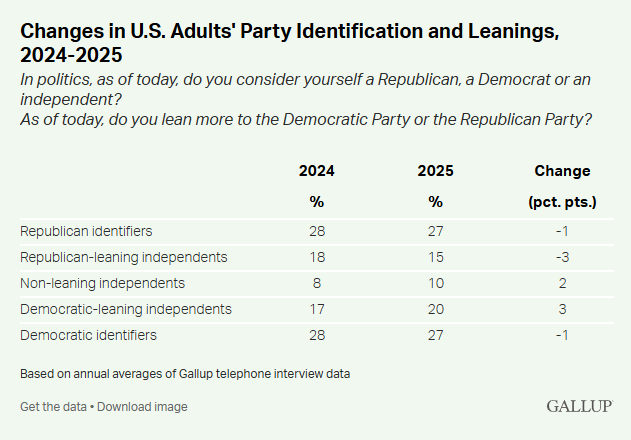
Gallup's annual surveys, based on more than 13,000 interviews, found that 27% identified as Democrats and 27% as Republicans, each down one percentage point from 2024.
Among the 45% independents, 20% lean Democratic, 15% lean Republican, and 10% lean toward neither.

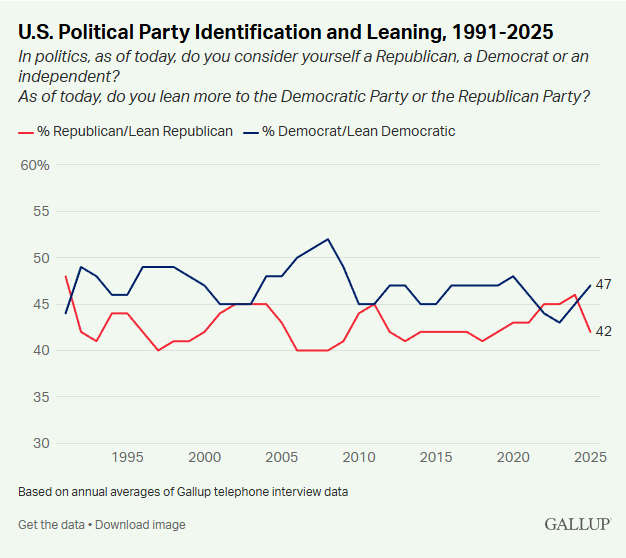
Combined party identification and leanings give Democrats a 47% to 42% edge over Republicans, ending a three-year Republican advantage and reverting to patterns seen during Trump's first term.
The shift accelerated dramatically over 2025.
Republicans held a four-point lead in late 2024 during the election and transition period. That evaporated in the first quarter, flipped to Democratic parity, then grew to a three-point Democratic lead in the second quarter, seven points in the third, and eight points by year's end.
Younger generations drive the independent surge.
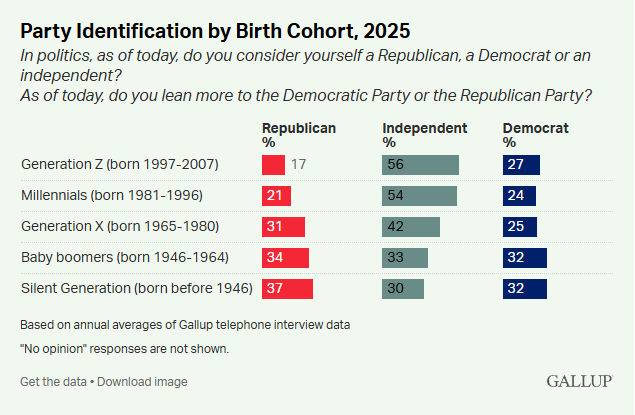
Majorities of Gen Z (56%) and millennials (54%) identify as independents, along with more than four in 10 Gen X adults.
Only one-third or fewer of baby boomers and Silent Generation adults do so.
Today's young adults show higher independent rates than prior generations at similar ages—56% for current Gen Z versus 47% for millennials in 2012 and 40% for Gen X in 1992.
Ideologically, conservatives maintain a narrow lead: 35% describe themselves as very conservative or conservative, compared with 28% liberal and 33% moderate.
The seven-point conservative advantage is the smallest since 1992.
These numbers signal deep disillusionment with both parties.
Americans are fleeing labels, yet the Democratic tilt among independents reflects backlash against the incumbent rather than genuine affection for Democrats, whose favorability ratings remain historically low.
America is fracturing along generational and ideological fault lines. The two-party stranglehold is cracking under the weight of distrust, and independents—especially the young—are the wedge.
The era of party loyalty is dying; the age of volatile, anti-incumbent swings is here to stay.