Table of Contents
The Face-off
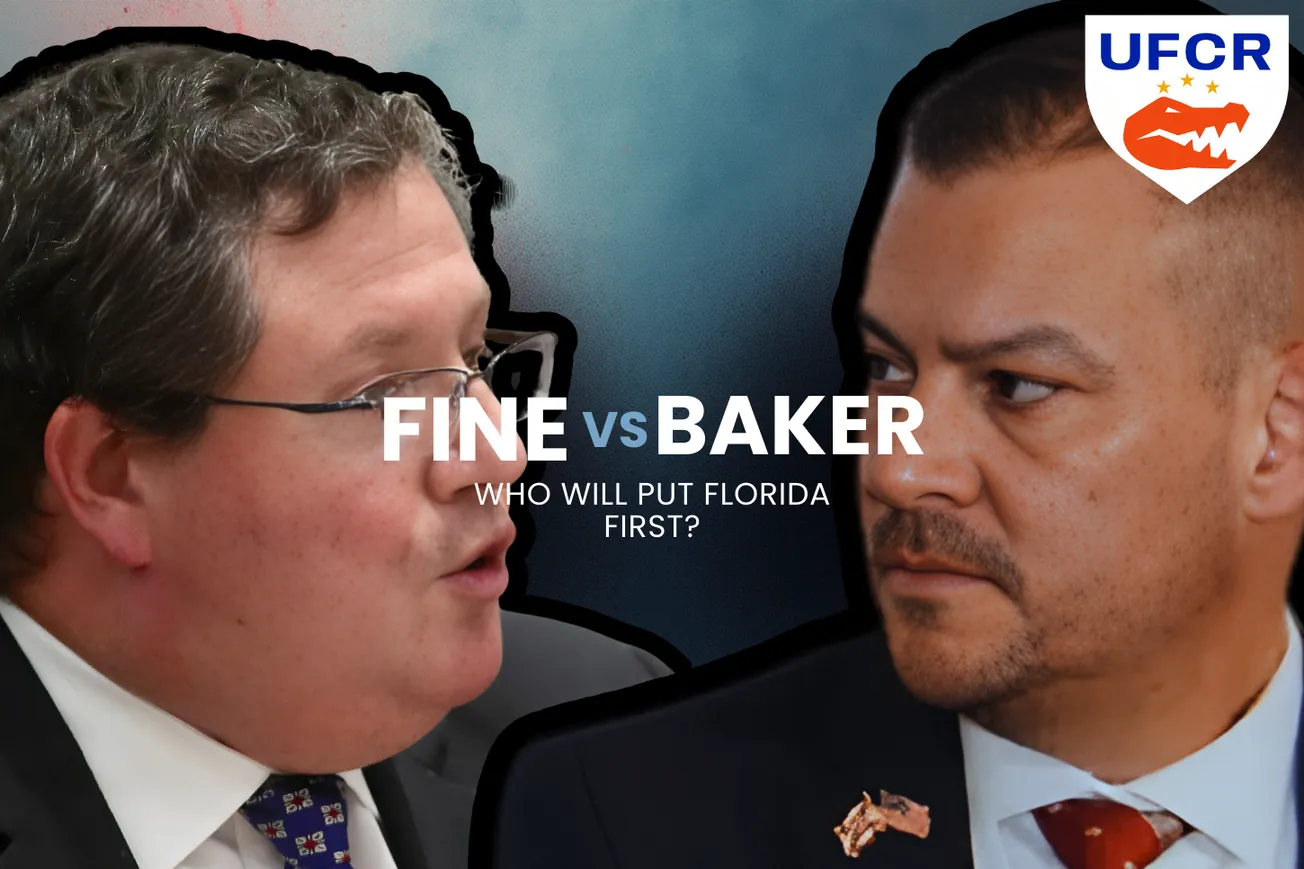
Randy Fine, who is running for re-election in Florida’s 6th Congressional District, is up against Aaron Baker in the 2026 Republican primary. Both men are Republicans, but their ideas are very different. Fine, a politician with Trump’s support and nationwide name recognition, represents the party’s hardline, establishment-backed wing. Baker, on the other hand, is a local conservative activist who presents himself as a grassroots alternative focused on district-level issues. In a district that is safely Republican, this primary will ultimately choose the next U.S. Representative, allowing voters to choose between an outspoken insider and an outsider rooted in the community.
Profiles of Candidates
Randy Fine is a former gambling industry executive from Arizona who got into Florida politics in 2016. He was a member of the Florida House of Representatives from 2016 to 2024 and then briefly served in the state Senate in 2024 before running for Congress.
Fine is known for his aggressive, “bare-knuckle” style of politics and his strong support for the Trump-aligned agenda. Fine ran in a special election in January 2025 to replace Rep. Michael Waltz, despite not living in District 6 at the time. President Trump told him to do it.
Fine won the GOP primary and the special general election thanks to Trump’s support and a lot of money raised. Fine is said to have bought a condo in the district to meet residency requirements, but he openly says, “I’m not going to try to convince people I’m from there, because I’m not.”
Supporters of Fine see him as an experienced conservative warrior who isn’t afraid of controversy. Critics see him as a rude opportunist who cares more about national issues than local needs.
His opponent, Aaron Baker, was born in Lakeland and has lived in Sorrento (Lake County) all his life. He has never been elected to office, but he has built a reputation as a grassroots Republican activist and campaign worker. Baker’s background differs from Fine’s in that he has worked at the community level to organize conservative groups, speak out on local issues such as high property insurance rates and beach erosion, and fight for gun rights. In the special primary for this seat in January 2025, he ran for office for the first time and came in second with about 14% of the vote.
That quick race with few voters didn’t help him get his name out there, and a lot of voters didn’t know about Fine’s problems at the time. Baker is running again in 2026 as a “district-first” candidate who puts infrastructure, affordability, and personal freedoms ahead of the fighting and drama of national politics. He is more reserved and focuses on policy details at town halls, which he says is better for the community, even if it doesn’t make headlines. Supporters say this down-to-earth style makes him easy to relate to, but some worry Baker will have a hard time cutting through the noise of Fine’s loud media presence.
Past Performance and Issues
Supporters point to Fine’s work in Florida and with constituents when he first got to Congress. Some examples are:
Fine sponsored the Florida House version of the bill that ended Disney’s Reedy Creek special district framework (along with other special districts). This was a big deal in Florida state politics in 2022.
Indian River Lagoon restoration proposals (2019): Fine-backed laws and funding proposals aimed at cleaning up the Indian River Lagoon, including efforts that have been reported as seeking large amounts of recurring funding for restoration-related projects.
Federal funding claims and beach restoration attention (2025): Fine’s congressional office says it helped secure more than $20 million in federal funds for local projects, including beach restoration in Flagler County. Local news also reported that Fine helped move about $9 million in beach-related funding.
(Some of the things above are legislative actions or efforts to get funding, not finished projects. The effects can depend on how agencies and local partners carry them out.)
Randy Fine’s political career has also been full of scandals and inflammatory events that have gotten him both praise and criticism:
Fine verbally attacked a constituent, Paul Halpern, in 2019 when he was a state legislator. Halpern hosted a forum on the Israeli–Palestinian conflict. Fine called the event an “anti-Semitic rally” and even called Halpern a “Judenrat,” which is a negative word for Jews who worked with Nazis. People from all political backgrounds in the community were shocked by the Holocaust reference and told Fine to say sorry. (He didn’t.)
Allegations of Abuse of Power: In April 2023, the Florida Commission on Ethics found enough evidence to believe that Fine may have misused his office in a case involving local funding. A member of the Brevard County school board said that Fine threatened to cut state funding for flood control projects in West Melbourne and even a Special Olympics fundraiser because he felt insulted at a ceremony. Fine said he didn’t do anything wrong, but the incident added to his reputation for using dirty political tactics. (The ethics case was still open at that time.)
Comments to deflect to Israel: At a meeting of the Republican Jewish Coalition in late 2024, he said that “America will not be safe for Jews if Kamala Harris wins” the presidency. He accused the vice president of “fully embracing Muslim terror.” He even said that if the Democrats won, he and his family (Fine is Jewish) might have to flee to Israel.
Fine has publicly insulted elected officials from both parties, which has caused problems with coworkers. In April 2025, after Rep. Ilhan Omar criticized the Israeli government’s actions, Fine tweeted back to her, “I’m sure it’s hard to see us welcome the killer of so many of your fellow Muslim terrorists.” The only wrong thing is that you are in Congress.
He also told Representatives Omar and Rashida Tlaib that “the ‘Hebrew Hammer’ is coming,” which is what he calls himself. His words made House Democratic leaders Hakeem Jeffries, Katherine Clark, and Pete Aguilar call them “bigoted and disgusting” and ask him to say he was sorry.
Extreme Views on Israel and Palestine: Fine’s aggressive stance on the Israel-Palestine conflict may be the thing that best defines him. He is one of the most outspoken pro-Israel and anti-Palestinian members of Congress. Fine has shown no sympathy for Palestinian civilians over and over again, often calling them terrorists or acceptable collateral damage. In a 2021 social media post, a user shared a picture of a Palestinian child who had been killed in an airstrike and asked Fine how he sleeps at night. He replied, “Quite well, actually! Thanks for the picture!” He has said that he “doesn’t feel bad” when Palestinian civilians are killed because he thinks Hamas uses them as “human shields” and blames their deaths on Palestinian militants. Fine’s words reached new lows during the Gaza conflict from 2023 to 2025. As news spread in July 2025 that children were starving in besieged Gaza, Fine wrote, “Release the hostages.” Until then, go ahead and starve. (This is all a lie anyway; the media keeps spreading lies about Muslim terrorists.)
The remarks sparked widespread backlash, as they were widely interpreted as endorsing mass starvation. AIPAC would go on to quietly stop supporting Fine because of the comment. Rep. Marjorie Taylor Greene said that Fine’s call for the continued starvation of innocent people and children is “disgraceful.” Fine noted that Hamas propaganda had fooled his critics and that he didn’t regret saying “starve away.”
Aaron Baker, on the other hand, has a short public record and no similar scandals. Because he has never held office, he has never had to deal with ethical complaints or make policy decisions. People think of Baker as an outsider with a clean slate. Supporters say he isn’t involved in any political scandals because he has spent his career organizing campaigns and supporting conservative causes. But his short track record also supports what his opponents say about his inexperience. Baker ran for office only once, in the 2025 primary, where he received a small percentage of the vote.
Without any legislative successes or failures, voters will have to judge him mostly on what he says he stands for and his character. This makes a big difference: Fine has been in the legislature for eight years, which comes with a lot of baggage, while Baker is new and has none. A big question in this primary is whether voters would rather have a politician who has been through many fights and is controversial, or a new face with no proven skills.
Positions on Foreign Policy
Randy Fine: Fine’s views on foreign policy are primarily based on an unwavering defense of Israel. He proudly calls himself “perhaps Congress’s loudest pro-Israel voice” and says that supporting Israel “at any cost” is a big part of who he is. Fine strongly supports what the Israeli government does and often links criticism of Israel to antisemitism or support for terrorism. For instance, as a state lawmaker, he even tried to keep any flag that was seen as “political,” like the Palestinian flag, out of public buildings in Florida.
He called it a “terrorist rag” and said, “In Florida, if you support Muslim terror, you will be treated like a Muslim terrorist,” referring to people who want Palestine to become a state. Fine’s rhetoric during the Israel-Hamas conflict is very different from what most people say. He has supported using overwhelming military force (even talking about nuclear strikes on Gaza) and calls for ceasefires or negotiations as foolish. His position appeals to hawkish voters and hardline Zionist groups that see him as a brave fighter against antisemitism. But it also worries some other Republicans and others who think Fine’s focus on Israel and inflammatory style could hurt American interests and make sectarian tensions worse. Some people in District 6 have said that Fine seems to care more about Israel’s problems than their own because he spends so much time on Middle East issues. Fine, on the other hand, says that it is in America’s best interest to protect Israel and fight anti-Israel sentiment. He frames this as a fight between civilization and terrorism.
Aaron Baker: Baker believes in a “America First” foreign policy that is very different from Fine’s hawkishness about intervention. He stresses the importance of the U.S. national interest and the need to be wary of getting involved with other countries. Baker does support Israel’s right to exist and defend itself, but he thinks the U.S. shouldn’t be the world’s police and should take a more measured approach to foreign conflicts. He has said that “undue influence of foreign lobbies” has sometimes taken over American policy and pushed the US into wars that don’t help the American people directly.
Baker uses the war in Ukraine as an example of a “costly proxy war.” He doesn’t want the U.S. to give Ukraine any more money or weapons, saying that Europe needs to do its part and that a negotiated peace is needed right away instead of more fighting.
This position is in line with a growing group of conservatives who are against giving blank-check support to wars in other countries. Baker also backs the idea of a two-state solution to the Israeli-Palestinian conflict, as former President Trump did for peace in the Middle East. He thinks this is the best way to protect Israel’s security and give Palestinians control over their own affairs. Baker’s overall instinct in foreign policy is to be careful. He believes that American security should come first (for example, by keeping borders safe and making the country energy independent) and that military action should be taken only when necessary. He says that before trying to build a strong nation abroad, we should focus on keeping the peace at home. Baker’s view may be a breath of fresh air for voters who are sick of endless wars abroad or significant aid commitments. But more hawkish Republicans are worried that his plan could make the U.S. less supportive of its allies and less powerful abroad. The primary is basically a test of foreign policy: Fine’s vigorous defense of Israel and confrontational stance versus Baker’s more isolationist, “focus at home” philosophy.
Local Issues and Domestic Policy
Randy Fine: Fine’s views on domestic policy are primarily in line with those of mainstream conservative Republicans, but he has led some high-profile fights in his own state. Fine was a supporter of Governor Ron DeSantis on important culture-war issues while he was a state representative. He was a key figure in dismantling Walt Disney World’s special self-governing tax district during a fight between Disney and Florida’s government over social policies (Disney’s special district was changed in 2023 with Fine’s help). Fine was also concerned about environmental issues in his area. For example, he secured funding to clean up the polluted Indian River Lagoon in Brevard County, which he often cites as a local success. Fine is very strict when it comes to crime and immigration. He helped write laws to make it harder for undocumented immigrants to live in the US, such as making crimes punishable by harsher penalties. He has been a strong supporter of law enforcement and the “tough on crime” approach. Fine is also a strong supporter of gun rights. One of his first acts as a senator was to file a bill to lower the legal age to buy rifles and long guns from 21 to 18. This was a change from a restriction that was put in place after the Parkland shooting. He said that 18-year-olds should be able to buy guns at home if they can serve in the military.
The Second Amendment groups liked that idea, but the gun control groups didn’t. Fine says he is a pro-growth, low-tax Republican who usually supports deregulation in the economy. Fine is more likely to support a traditional free-market approach than some Trump-aligned populists. For example, he has said he doesn’t support tariffs or trade wars that could raise consumer costs, which puts him at odds with America First protectionism. Fine’s primary goal in Congress has been to bring Florida’s conservative policies to the federal level. He supports vigorous border enforcement (including ICE deportations), is against federal COVID-19 mandates, and wants to cut federal spending except for defense and veterans. People who like how Florida has changed under Republican rule may see Fine as someone who will keep doing things the same way in Washington. Some people, though, say that Fine’s focus on national ideological battles (like fights over flags or pronouns) takes attention away from the district’s critical issues.
Aaron Baker: Baker’s campaign focuses a lot on local and economic issues that affect daily life in District 6. He often talks about how hard it is for families in Florida to afford rising homeowners’ insurance premiums, high gas and grocery prices, and a lack of affordable housing. Baker wants to solve these problems by reducing the federal government’s involvement and cutting red tape. For example, he wants to make energy cheaper by lowering federal fuel taxes or rules that he says make it more expensive. Baker’s main point is that the government should “get out of the way” so that small businesses can grow. He wants to make it easier for small businesses to obtain permits and pay lower taxes. He thinks this will create jobs and help families with their money. Baker also places great importance on the local environment and infrastructure. District 6 covers parts of Florida’s Atlantic coast, and Baker often talks about beach erosion, flooding, and traffic jams on the roads. He backs targeted federal funding to strengthen shoreline defenses and improve drainage so that floods don’t cause damage. He has also pushed to improve regional infrastructure, such as highways and bridges, to keep up with growth, often noting that new residents and tourists are straining local roads. Baker supports vocational and technical training programs to strengthen workforce education in Florida. He says not every student needs a four-year college degree and wants the district to allocate more funds to trade schools, apprenticeships, and medical technician programs. Baker also agrees with Republicans that education standards and curriculum should be set more locally. He wants to limit the federal Department of Education and give Florida more say in school policy. He supports gun rights and is against new gun restrictions. He also emphasizes helping military veterans, such as ensuring they can access VA services. One of Baker’s main ideas is to make the Small Business Administration more visible. He wants to open an SBA office in every congressional district so that new business owners can get help and advice easily.
This idea shows that he views the federal government as a means to help communities more directly. But it might mean hiring more federal workers and spending more money, which fiscal conservatives might not like. To sum up, Baker’s domestic platform is based on solving problems in Florida, such as lowering costs, building infrastructure, and empowering local institutions. Baker’s focus on bread-and-butter issues might appeal to voters who are tired of partisan fights and culture-war laws. The trade-off is that, as a newcomer, it’s hard to say how well he would be able to push this agenda in Washington, especially since he doesn’t have the power or committee positions that Fine has as an incumbent.
Campaign Help and Money
Randy Fine: Fine’s campaign is backed by significant funding and prominent supporters. He has received donations from a wide range of influential groups thanks to his well-known political network. Many corporate PACs, including those from big telecom companies like Comcast and T-Mobile, defense contractors like Boeing and General Dynamics, and big health insurers like Elevance Health, Centene, and Cigna, have given money to Fine’s congressional campaign, according to records.
These contributions suggest that many industries see Fine as a powerful ally. This may be because he sits on committees that deal with health policy and foreign affairs, and has a consistent pro-business, pro-defense voting record. Fine has also gained a lot from groups that support Israel. In 2025, the powerful AIPAC backed him and helped him get donations from many people.
Some people say that Fine got more than six figures in total support from pro-Israel groups and donors during his special election run. AIPAC and other groups distanced themselves from Fine after he made controversial comments about Gaza in 2025, but that happened later in the cycle. Fine’s close relationship with President Trump has also opened the floodgates for fundraising: Trump headlined virtual rallies and fundraising appeals for Fine, and Trump-aligned PACs gave a lot of money to the race.
Fine has been able to fill the local airwaves with ads, send mailers to every district, and build a professional campaign organization thanks to this war chest. Fine’s campaign has raised millions of dollars, which is a lot of money for a House race and much more than his opponent has. The incumbent has even more financial support from the GOP establishment: he has endorsements from well-known Republicans and access to national party data and infrastructure. Baker and his allies have criticized this level of support, saying that lobbyists and other special interests have “bought and paid for” Fine. Fine’s team says that the money he raises shows that many people support his plans and that he remains in line with his voters. Fine is the clear favorite in the primary when it comes to money and organization, no matter what.
Aaron Baker is running a shoestring campaign with the help of regular people rather than big money, unlike Fine’s. He often proudly says that he hasn’t taken a dime from corporate PACs or federal lobbyists. His money comes from small donations from people, many of whom live in Florida. By the end of the third quarter of 2025, Baker’s campaign had only brought in about $53,000, a minimal amount for a race for Congress. Baker’s own money, either given or loaned to his campaign, made up about 20% of that amount (about $11,000).
In other words, Baker is mostly paying for a small business on his own, with the help of a few local fundraisers and online donations. Volunteers mostly run his campaign. For example, local Republican clubs and student groups have helped him knock on doors, and his family members help him plan the campaign. Baker’s grassroots approach drives home his message of independence and principle. He says that because he doesn’t owe anything to big donors, he would only be accountable to the people of the district. But the downside of not having much money is that it limits your reach. Baker can’t afford to run ads on TV or send out constant mailings, so he drives around the district in his own pickup truck instead of a campaign bus. Fine’s polished ads run on Fox News, but Baker uses social media videos and in-person events to get his name out there. The fundraising gap makes things more challenging: Fine’s message just reaches more voters right now. Baker has tried to make this an underdog story by telling his supporters to show that a “grassroots candidate” can beat big money. It is still a hard fight. Political experts say that in today’s elections, it’s hard to win when you’re behind by such a large margin, especially when you’re running against an incumbent. Baker’s shoestring campaign is at a significant disadvantage in terms of visibility unless it can get a lot more volunteer energy or free media attention. The question is whether GOP primary voters are unhappy enough with Fine that word of mouth and support for Baker can make up for the money he needs.
The Republican Candidate for District 6
This primary election will decide which type of Republicanism will represent Florida’s 6th District in Congress. Because the district is very conservative, this will basically determine the seat. Voters have two very different choices: Randy Fine, the brash incumbent who offers experience, high-profile endorsements, and an unapologetically hardline agenda; and Aaron Baker, the grassroots insurgent who promises a fresh start, a focus on local issues, and a return to basic conservative principles without the drama. Fine’s supporters say his aggressive style and connections in Washington give the district a louder voice. They point to his ability to attract attention and secure resources. People who support Baker say the district needs a representative who lives in and understands the community, not someone trying to make a name for themselves on the national stage. In many ways, this race is a vote on where the GOP is going. Will the Republican base choose the experienced “MAGA warrior” who takes an all-or-nothing stance on issues like Israel and culture wars? Or would they rather have a more low-key, America-first conservative who emphasizes helping constituents and being careful with foreign policy? The result will show which vision Republican voters prefer in 2026. On primary day, the Republicans in District 6 will be answering a bigger question: Do they want the fiery, establishment-backed fighter or the principled, homegrown reformer to carry their banner? The answer will set the direction for the district’s representation and, to some extent, show how the party is doing at the grassroots level in Florida.