

Table of Contents
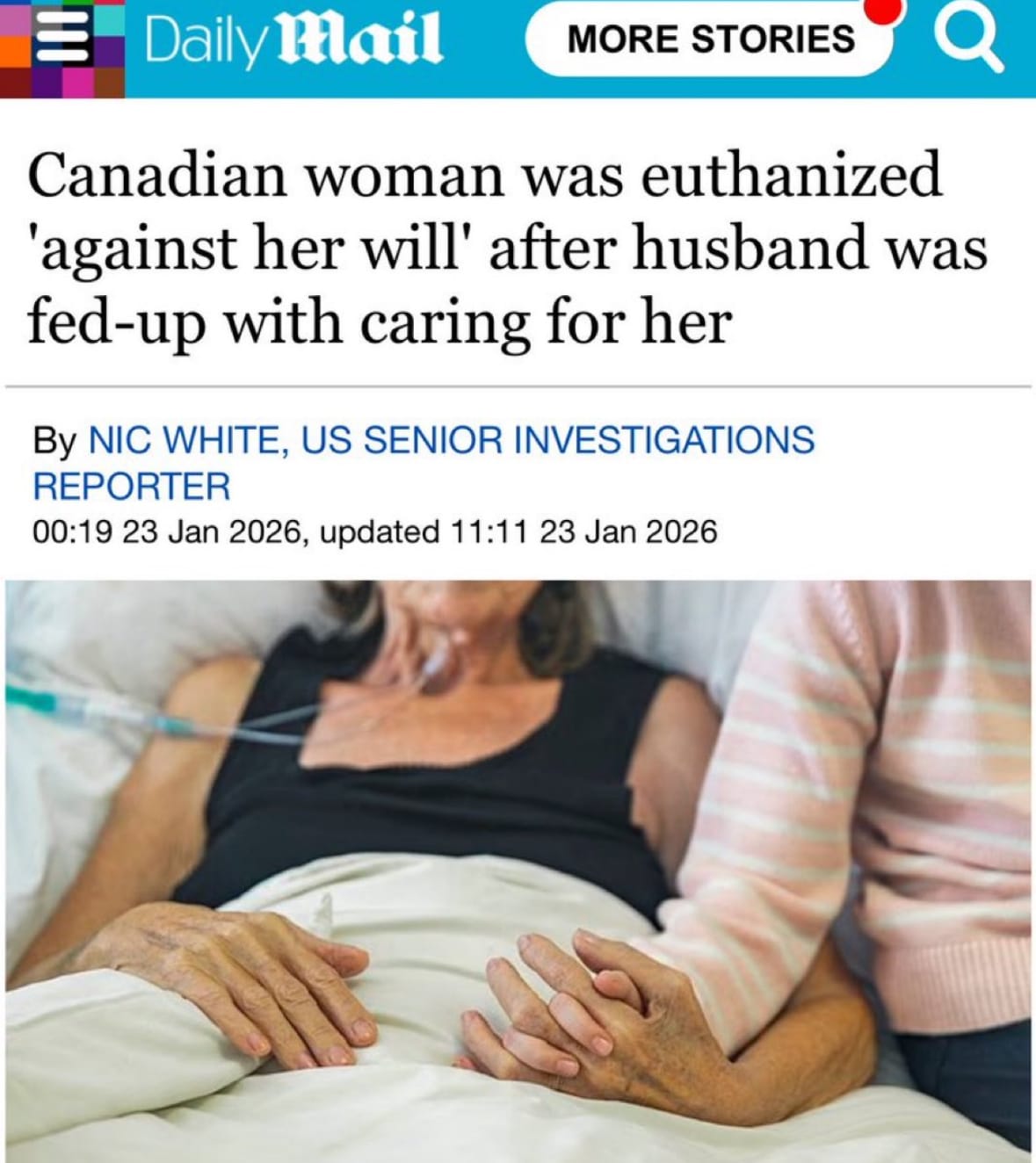
A recent Daily Mail article has circulating on social media claims a Canadian woman was euthanized against her will.
Euthanasia is not new to the scene in Canada. It has been long debated and protested. While the ethical and moral concerns are evident, could there be other implications that have not yet been addressed?
Canada legalized euthanasia in 2016 under the reassuring title Medical Assistance in Dying (MAID), while the United States first permitted physician-assisted suicide in Oregon in 1997 and now allows it in 10 states.
Canada's framework has expanded far beyond its original scope, becoming the most permissive euthanasia system in the world.
In 2022, more than 13,000 Canadians died through MAID, a 31 percent increase over the previous year.
In 2023, the number deaths exceeded 15,000, representing roughly one in every 20 deaths nationwide and the numbers continue to rise.
Despite the scale, there is no independent authority that pre-approves cases or systematically investigates coercion or abuse. Oversight is largely retrospective, relying on paperwork submitted after death.

There is also no legal requirement for patients be offered or exhaust alternatives such as palliative care, disability services, housing assistance, or long-term treatment before death is approved.
Canada planned to expand MAID to individuals whose sole condition is mental illness, including PTSD and severe depression. Following strong backlash from psychiatrists, veterans' groups, and disability advocates, the government delayed the expansion until at least 2027, though it remains official policy.
Parliament is also considering whether to allow "mature minors" to access MAID for psychological suffering.
Critics argue financial and systemic pressures undermine true consent. Many disabled or chronically ill Canadians face long waitlists, poor home care, housing insecurity, and high costs. When adequate care is scarce but euthanasia is easily available, and far cheaper for the state, the choice is may not be fully voluntary.
Government data also reveals a striking demographic pattern among MAID recipients.
According to the most recent federal reports, approximately 95-96% of those who receive euthanasia in Canada self-identify as Caucasian (White), with all other racial and ethnic groups, including Indigenous Canadians, collectively accounting for a small fraction of cases. Health Canada cautions that racial data is voluntary and incomplete, but the consistency of the figures year over year has raised questions about cultural, socioeconomic, and access-related factors that influence who chooses MAID.
This demographic reality stands in contrast to Canada's rapidly changing population, shaped by immigration. India has been the largest source country for new permanent residents to Canada, accounting for around 27% of newcomers in recent years, with China, Afghanistan, Nigeria, Pakistan, and other countries also contributing significant shares of total immigration. Indians alone accounted for well over a quarter of all new permanent residents in 2022, with similar patterns continuing into 2023 and 2024.

Taken together, these trends raise an uncomfortable question that Canada’s political class not only refuses to confront but labels as an extremist concern.
As mass immigration rapidly reshapes the country bringing in millions from cultures where euthanasia is morally rejected or outright forbidden the burden of Canada’s assisted-death regime falls overwhelmingly on its legacy population. The data shows who is dying, while immigration statistics show who is arriving. One population is expanding; another is being quietly reduced.
When a state makes life harder to sustain than death, and simultaneously replaces its population through unprecedented immigration, the result is not neutral policy, it is demographic transformation by design.
Whether driven by cost containment, ideological commitment, or bureaucratic inertia, the outcome is the same: a country that solves social failure not by care, support, or solidarity, but by elimination.
Canada is no longer simply debating euthanasia. It is running a live experiment in population management where some lives are prolonged through migration, and others are shortened through policy.
Is this compassion or replacement with a syringe, execution approved by physicians, and sold as progress.