
Table of Contents
Two Republican primaries in Central Florida are running on parallel tracks this summer, and the same Mount Dora law office sits at the center of both. One race is loud with a social media celebrity with thirty million followers spending the spring insulting the incumbent and drawing national headlines in Florida’s 6th Congressional District. The other race is quiet while in the neighboring 11th District, a field of America First contenders has thinned out in the final days before qualifying closed, leaving more of a cleared path for a single establishment-friendly name.
The documents that connect these two stories were public the entire time as they sat in federal campaign filings, in a state candidate oath stamped and received by the Division of Elections, and in the candidates’ own published words. What follows is an attempt to lay those records side by side and let the sequence speak for itself.
A Shared Address
Daniel Brandon Bilzerian filed his Statement of Organization with the Federal Election Commission on April 7, 2026, registering a principal campaign committee to challenge Representative Randy Fine in Florida’s 6th District. The committee, Bilzerian for Congress, lists its address as 1601 East 1st Avenue in Mount Dora. That address is the registered location of the law firm of Anthony Sabatini, the Lake County Commissioner and former state representative, a fact confirmed against the state’s corporate registry and reported at the time by multiple Florida outlets.
The federal filing also names Patrick Krason as both treasurer and custodian of records, with a committee email routed through a political consulting firm. Krason previously served as treasurer for the short-lived presidential campaign of the artist formerly known as Kanye West, a detail that has been documented in national reporting on Bilzerian’s launch.
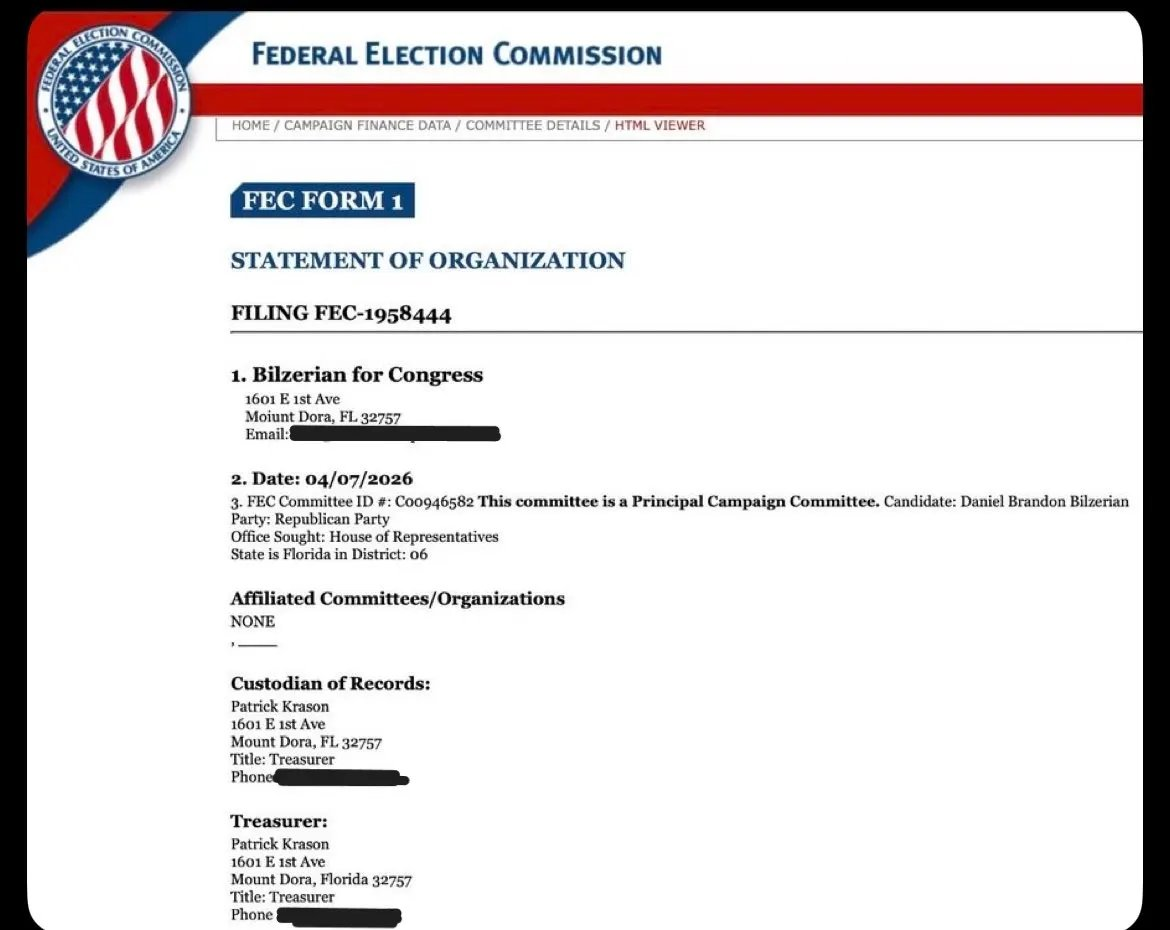
On its own, a shared committee address proves little. Campaign committees register at law offices, accountants’ suites, and post office boxes as a matter of routine, and the location of a committee says nothing about where a candidate lives. The address became more significant only when a second, sworn document surfaced.
The Oath and the License
On June 8, 2026, at 1:44 in the afternoon, the Florida Division of Elections in Tallahassee received Bilzerian’s Candidate Oath for federal office. The form, notarized two days earlier in Volusia County, is the document that carries legal weight, because a candidate swears to its contents before a notary.
On the line marked Address of Legal Residence, the oath lists the same Mount Dora address as the law office. The candidate swore to Florida residency. Yet the notary block records the identification produced for that act as a Nevada driver’s license.
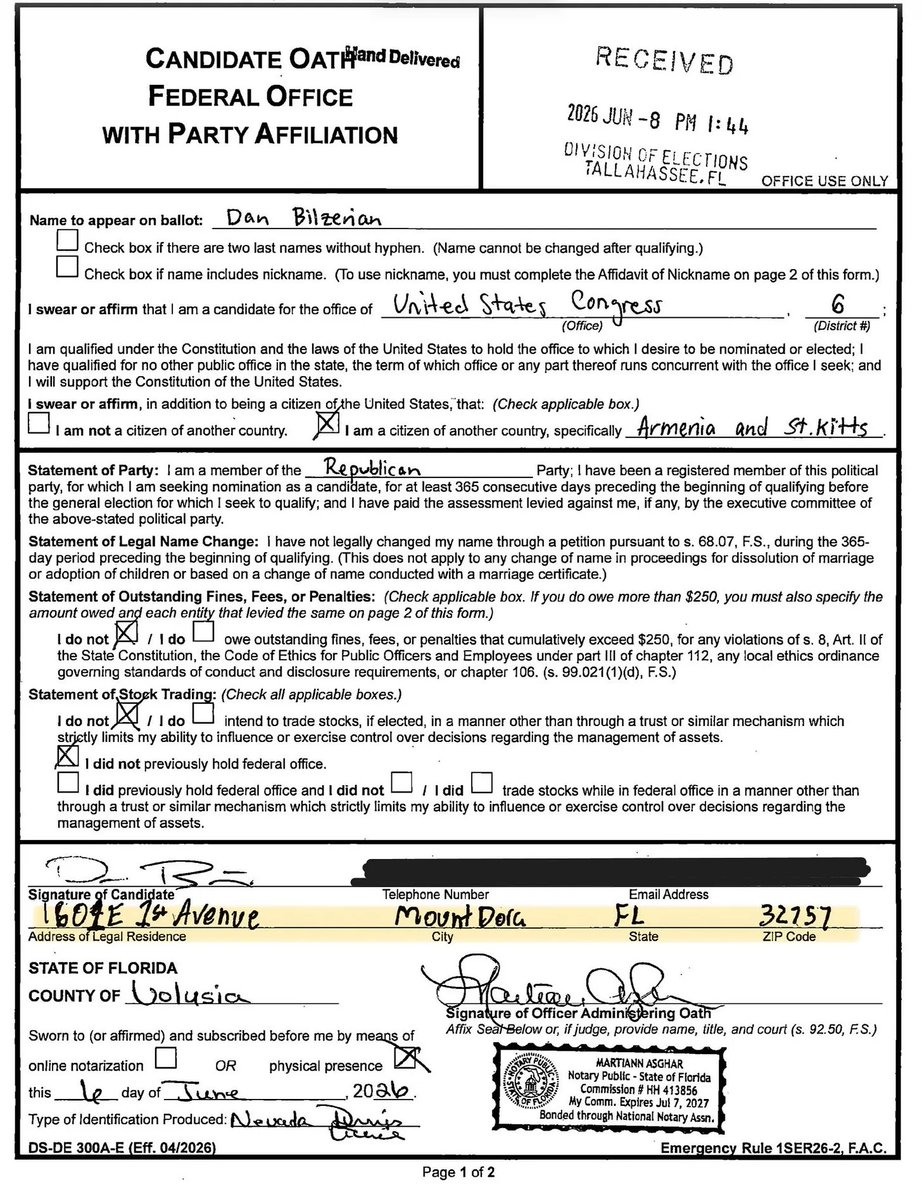
The tension here is worth stating carefully, because it is easy to overstate to say the least. The Constitution requires a member of the House to be an inhabitant of the state when elected, not of any particular district, and courts have read that requirement loosely for generations. A Nevada license does not disqualify anyone from a Florida congressional race, but what the oath does is raise a fair question about whether the sworn Florida residence reflects where the candidate actually lives, or whether it reflects an address of convenience offered by a political ally. That question belongs to voters and, if anyone files a challenge, to the qualifying authorities; it is a question the document invites rather than answers.
One claim should be set aside entirely and that is the candidate oath is complete and valid on its face. The candidate’s signature appears on the sworn page, witnessed and sealed by the notary. The filing is clean but a different line on the same page is where the trouble lies.
The Sworn Statement
The oath asks for more than a signature and an address. In the Statement of Party, a candidate seeking a party’s nomination swears that he has been a registered member of that party for at least 365 consecutive days before qualifying begins. The requirement comes from section 99.021 of the Florida Statutes, and the Division of Elections stated the cutoff for the 2026 cycle without ambiguity. A candidate had to have completed any change of party affiliation by April 20, 2025, for the first qualifying period, or by June 8, 2025, for the second. Bilzerian checked the box and swore to the statement.
The public record is hard to reconcile with that oath. In early April 2026, days before he filed his federal paperwork, the supervisors of elections in Volusia and Flagler counties confirmed to the Daytona Beach News-Journal that Bilzerian was not then registered to vote in Florida at all. He had been registered in Florida years before, in Alachua and Hillsborough counties, and had since been associated with Nevada, the state whose license he later produced for the notary. As of that reporting he carried no active Florida registration, and he said himself that he expected to be registered “within about a week”.
That timeline cannot reach a year. A man who held no Florida voter registration in early April 2026 could not have been a registered Florida Republican for the 365 consecutive days preceding a qualifying period that opened in June 2026. The precise day he re-registered is kept in the county voter file rather than the state candidate system, so it is not posted online, but it does not alter the arithmetic which is that the window is only a matter of weeks, not the year that the oath requires.

A caution belongs here as well, because the campaign’s answer is predictable and not frivolous. For federal office, the Supreme Court held in United States Term Limits v. Thornton that states may not add qualifications beyond the three the Constitution sets for the House, namely age, years of citizenship, and inhabitancy in the state. Bilzerian’s attorneys could possibly argue that Florida’s 365-day party requirement is precisely such an added qualification, void as applied to a congressional candidate, and that the sworn statement therefore carries no disqualifying weight however inaccurate it may be. Whether a durational party-registration rule is an unconstitutional qualification or a permissible ballot-access regulation is unsettled, and any challenge would rise or fall on that question.
It is worth being precise about what the state’s acceptance does and does not mean, because the stamp invites a misreading. The word RECEIVED records that the Division of Elections took custody of the paperwork on June 8. It is not a finding that the sworn contents are true, nor a ruling that the candidate is qualified. Qualifying officers conduct a facial review, confirming that the form is complete and the fee is paid, rather than an investigation into whether each oath holds up. The state did not approve a false statement. It accepted a filing, and any fault for the contents rests with the person who swore to them. Nor does the discrepancy freeze anything on its own. No candidacy is voided and no fundraising halts because a sworn line conflicts with the record. For the registration question to reach his place on the ballot, someone would have to file a formal challenge, and a court or qualifying body would have to rule against the headwind of the constitutional problem already described.
What remains, set apart from the legal contingency, is narrow and factual. A candidate swore under oath to a year of party membership that the public record indicates he did not hold. Whether that tells voters something about the man asking for their trust is a matter they have to weigh on their own.
A Candidate Against Himself
The more striking contradiction is one Bilzerian created for himself, and it requires no source beyond his own paperwork and his own website.
On the same oath, he checked the box affirming that he holds citizenship in another country, and he named two: Armenia and Saint Kitts. Saint Kitts and Nevis operates one of the world’s best-known citizenship-by-investment programs, in which foreign nationals obtain a passport in exchange for a qualifying financial contribution.
Set that sworn declaration beside his published platform. His campaign website calls for forcing full disclosure of dual citizenships in Congress and barring dual citizens from voting on matters touching their other country. It states that any politician who places a foreign country before America is committing treason. The platform that demands dual citizens be stripped of their votes was authored by a self-declared citizen of three nations.

This is the cleanest finding in the entire matter precisely because it cannot be spun because both halves are his. A reader does not have to trust a source, accept an inference, or follow a timeline to see it.
Claiming The Label
Every Republican in these two races flies the America First banner, some more loosely than others. The phrase has become the password of the moment in Florida’s Republican politics, and across the 6th and 11th Districts at least five candidates have claimed it. It has been stretched wide enough to cover figures whose records sit uneasily beneath it.
Bilzerian is the starkest example, and for reasons already on the table. A platform demanding that foreign loyalty be purged from Congress, written by a man who swore to two foreign passports, wears the label only with a bold asterisk. Sabatini’s claim is contested on his own turf which is that the Lake County Republican Party rejected his membership application this year, with local leaders accusing him of supplying Democrats with talking points rather than fighting them. Carey Baker is the most conventional figure of the group, a constant of Lake County officialdom for a quarter century and the contender that party regulars would find the easiest to absorb.
That leaves two names who carry the banner without a qualifier. Mike Wilnau in the 11th District and Aaron Baker in the 6th are the genuine America First entries, underfunded first-time challengers aligned with America First, the kind of candidates the movement exists for. They are also the two that are squeezed hardest by the tremendous maneuvering around them. One was pushed out of a crowded field. The other was buried beneath a louder man’s online only spectacle.
The Timeline
The strategic shape of these races appears more clearly when the entries and exits are placed in chronological order. The dates below are drawn from federal filings, the state qualifying record, contemporaneous Florida reporting, and the candidates’ own announcements. Where a precise filing date is not part of the public record, the entry is described by the period in which the candidacy was active.
- Late 2025 into early 2026: Aaron Baker, a Lake County general contractor who had challenged Fine once before, is again positioned as an America First candidate in the 6th District. Mike Wilnau, running in the 11th District, occupies the same lane as they run parallel.
- March 25, 2026: Bilzerian announces on social media that he intends to run against Fine.
- April 7, 2026: Bilzerian files his FEC paperwork for the 6th District, listing Anthony Sabatini’s Mount Dora law office.
- April 28, 2026: Representative Daniel Webster announces he will not seek reelection in the 11th District. Within hours, Sabatini files to run for the open seat.
- Early June 2026: Carey Baker, a former state legislator and longtime Lake County property appraiser, files for the 11th District. He is a documented Sabatini ally; the two had worked together on an unsuccessful bid to install Baker as county party chair.
- June 8, 2026: The state receives Bilzerian’s sworn candidate oath.
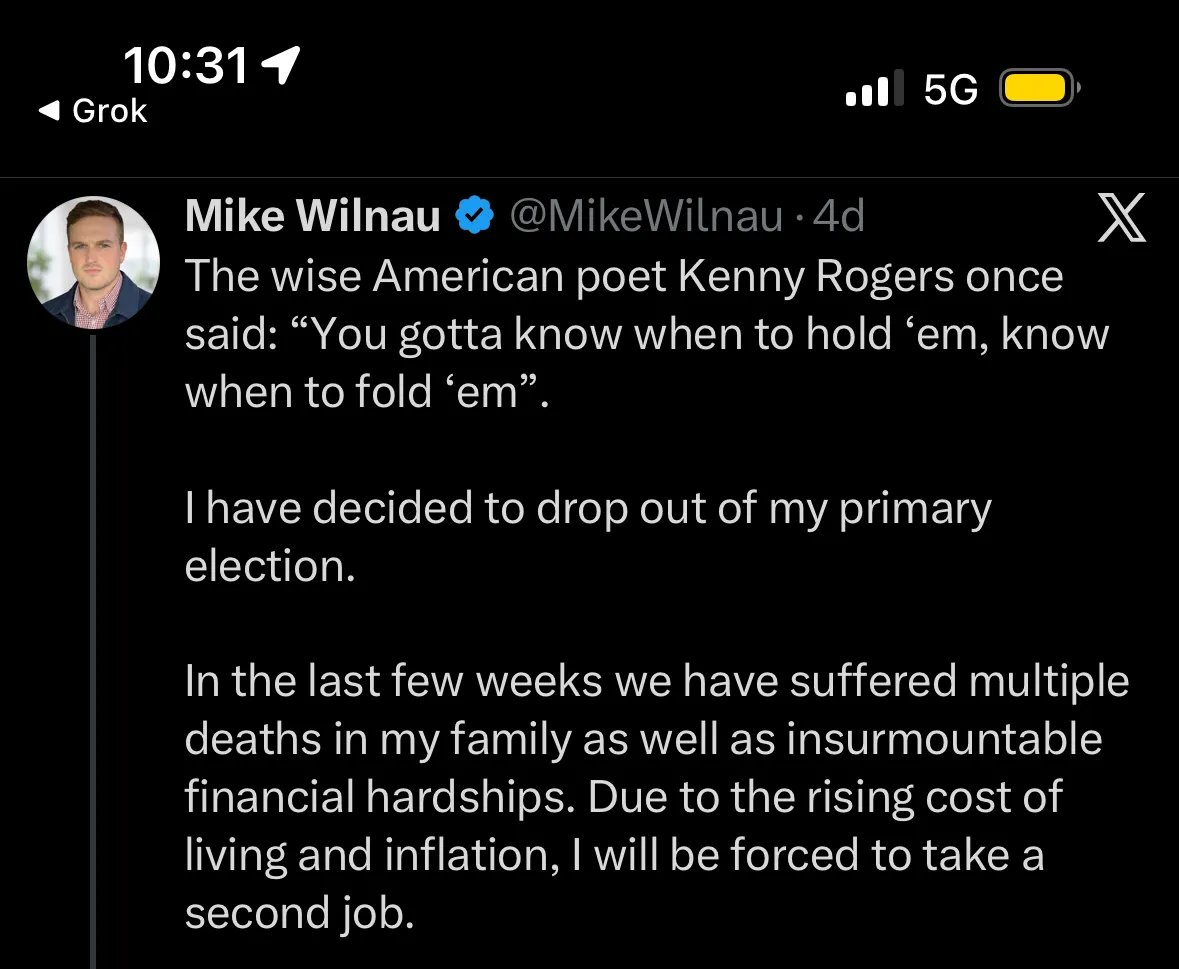
- June 9, 2026: Wilnau announces his withdrawal from the 11th District, citing recent deaths in his family and severe financial hardship.- June 10th, 2026: Carey Baker Formally files and enters the FL-11 race.
- June 12, 2026: Qualifying closes at noon. That evening, Sabatini announces his own withdrawal and endorses Carey Baker.
Laid end to end, the sequence shows a crowded America First field in the 11th District resolving, in the span of roughly seventy-two hours around the deadline, into a single consolidated candidacy. While the media spotlight in the 6th district of Florida is being shifted from Aaron Baker to Dan Bilzerian.
The Cleared Lane
The two exits in the 11th District each carry a public explanation that deserves to be taken on its own terms.
Wilnau’s stated reasons were grief and money. In the announcement, posted June 9, he wrote that his family had suffered multiple deaths in recent weeks, set against financial strain severe enough that the rising cost of living would force him to take a second job. He described himself plainly, an ordinary citizen and a father of four, a trade school graduate rather than a politician, who could no longer give the time a campaign demands while providing for his household and grieving at the same time. There is nothing implausible in a first-time candidate without institutional money reaching that conclusion, and the explanation is wholly his own. He is exactly the kind of grassroots candidate the America First movement claims to champion, and his departure removed one such candidate from the field.
Sabatini set out his reasons at length in a post to X on June 12, and he gave two. The first was the resign-to-run law. He had spent weeks in federal court trying to strike down the statute, which would have forced him to give up his Lake County Commission seat the moment he qualified for Congress. A judge declined to block the law in time for the qualifying deadline, and he cast surrendering the seat as irresponsible, warning that it could pass to a development-friendly insider. The second reason was arithmetic. He wrote that he and Carey Baker would have split too many votes in their shared home of Lake County to be competitive, invoked the decades since a Lake County figure last held the seat, and asked his supporters to line up behind Baker, whom he praised as honest and principled.
That second reason matters for how this story can be told. The vote-splitting logic at the center of the 11th District does not have to be inferred or sourced to any private account, because Sabatini put it in writing himself. By his own explanation, the field was consolidating to avoid dividing a Lake County base, and the beneficiary he named was his longtime ally. A separate sign that his primary path had narrowed came earlier, when a committee supporting him was ordered by lawyers for the President to stop implying a Trump endorsement.
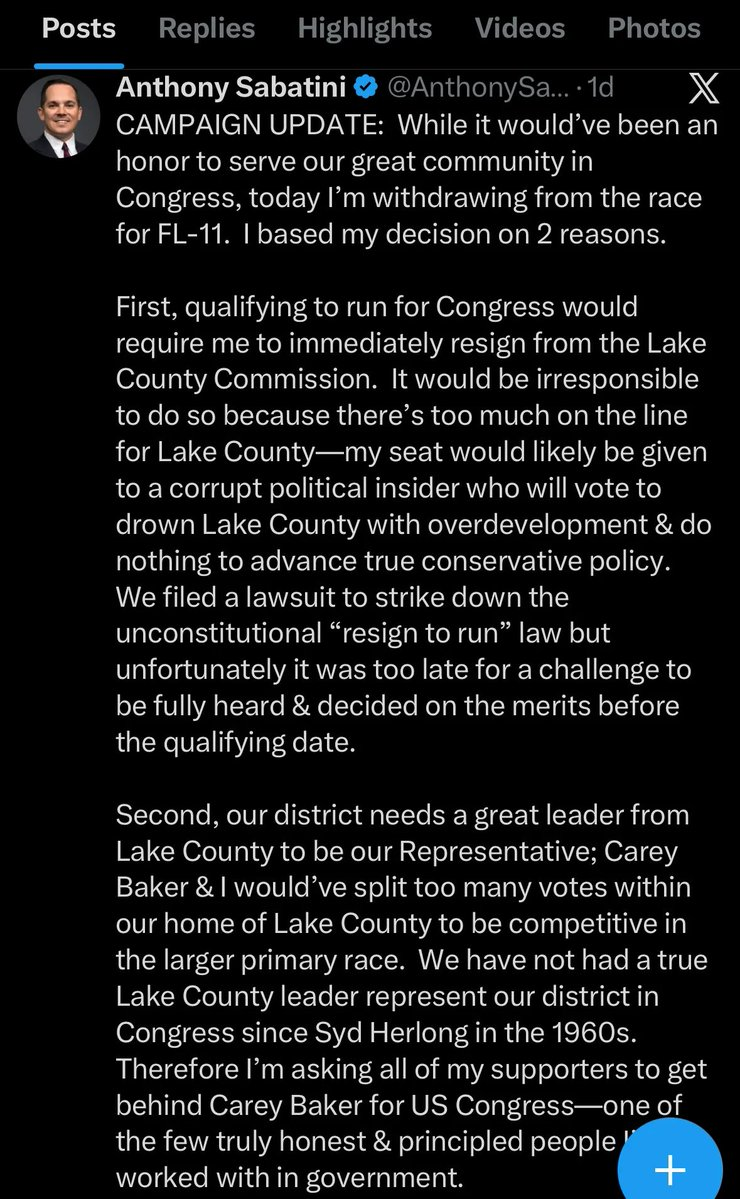
What the timeline establishes is whichever each man’s reasoning is, the combined result of the two withdrawals was to ease the vote-splitting that a crowded field produces and to leave the lane clearer for Carey Baker, an ally of the same commissioner whose law office address anchors the 6th District campaign next door. Effect is not proof of design, but it is, however, the pattern the record shows, and readers can weigh it against the explanations offered.
Two Districts, One Pattern
The larger question is whether the loud race and the quiet race are connected, or just adjacent. Here the evidence thins and honesty requires marking the seam.
The cleanest way to read the maneuvering is as two contests running at once. In the 11th District, Sabatini stood against Wilnau and the rest of a crowded field. In the 6th, Bilzerian stood against Aaron Baker, the America First challenger to Fine. The reading that the timeline invites are that the two contests were never truly separate, that Bilzerian and Sabatini, tied together by the Mount Dora office, were working the same problem from opposite ends, and that the path they cleared led to Carey Baker stepping into the scene last minute.
Bilzerian’s part in that reading is the spotlight. His thirty million followers and his steady output of inflammatory posts swallowed nearly all of the attention available in the 6th District, the same attention Aaron Baker needed to mount a grassroots case against an incumbent. A shoestring campaign cannot out-shout a celebrity who draws national coverage by insulting his opponent. Whether by design or only by effect, Bilzerian’s entry buried the one unencumbered America First challenger in his district while Sabatini managed the ground next door.
What is documented is a hub. Sabatini’s law office is the sworn residence of the 6th District celebrity candidate and the political home of the 11th District field that cleared for his ally. The same figure stands at the center of both stories. What is not documented is intent: there is no public record proving that Bilzerian’s spectacle was designed to pull attention away from grassroots challengers, or that the two races were coordinated as a single play. That inference is available from the timeline, and it is a reasonable reading of the sequence. It is not yet a proven fact, and this account will not dress it as one.
The strongest version of the skeptical case is simple. Bilzerian is a provocateur who generates attention wherever he goes, with or without a plan. Sabatini and Carey Baker are open, longtime allies whose mutual support surprises no one. Candidates drop out of crowded primaries to avoid splitting votes in every cycle, in every state. None of that requires a conspiracy.
The strongest version of the critical case is equally simple. A man with a Nevada license and a passport from a Caribbean investment program swore to a Florida address that belongs to a local power broker, while that broker’s own field conveniently consolidated behind a chosen successor in the district next door. The public record does not compel either reading. It does make both available.
What The Record Shows
Strip away the inferences and a documented core remains. A celebrity candidate swore to a residence at a political ally’s law office while presenting out-of-state identification. On the same oath, he swore to a year of Republican registration that the public record indicates he did not hold, having carried no Florida voter registration at all weeks before he filed. That same candidate, campaigning against foreign influence and dual loyalty, affirmed under oath that he holds two foreign citizenships. In the adjacent district, the field thinned in the final hours before qualifying and consolidated behind an ally of the same broker, after one grassroots contender cited finances and the front-running commissioner cited a legal bind.
Each of those facts is anchored in a document or a public statement. The line connecting them into a single coordinated design is the part that remains unproven, and it is offered here as a question the timeline raises rather than a verdict it delivers. What is harder to dispute is who absorbed the cost. The two candidates who carried the America First label without contradiction, Wilnau and Aaron Baker, are the two left worst off by the maneuvering around them, one out of the race and the other starved of the attention a challenger needs to be heard. The receipts were public all along. What they add up to is now a matter for voters in two districts to decide before August.
A note on this reporting. The factual claims here come from public records: federal campaign filings, state qualifying documents, county election officials, and the candidates’ own posts. The description of these events as coordinated is the author’s analysis of the sequence of events.