Table of Contents
On May 19, 2026, voters in Kentucky’s 4th Congressional District went to the polls in what political observers have called the most expensive primary election for a U.S. House of Representatives seat in the country’s history. Total ad spending in the contest between five-term Republican incumbent Thomas Massie and Trump-endorsed challenger Ed Gallrein climbed to approximately $32 million in tracked advertising and to an estimated $35 million when all outside expenditures are included. The bulk of the money came from outside organizations like super PACs and a handful of billionaires rather than from the candidates themselves.
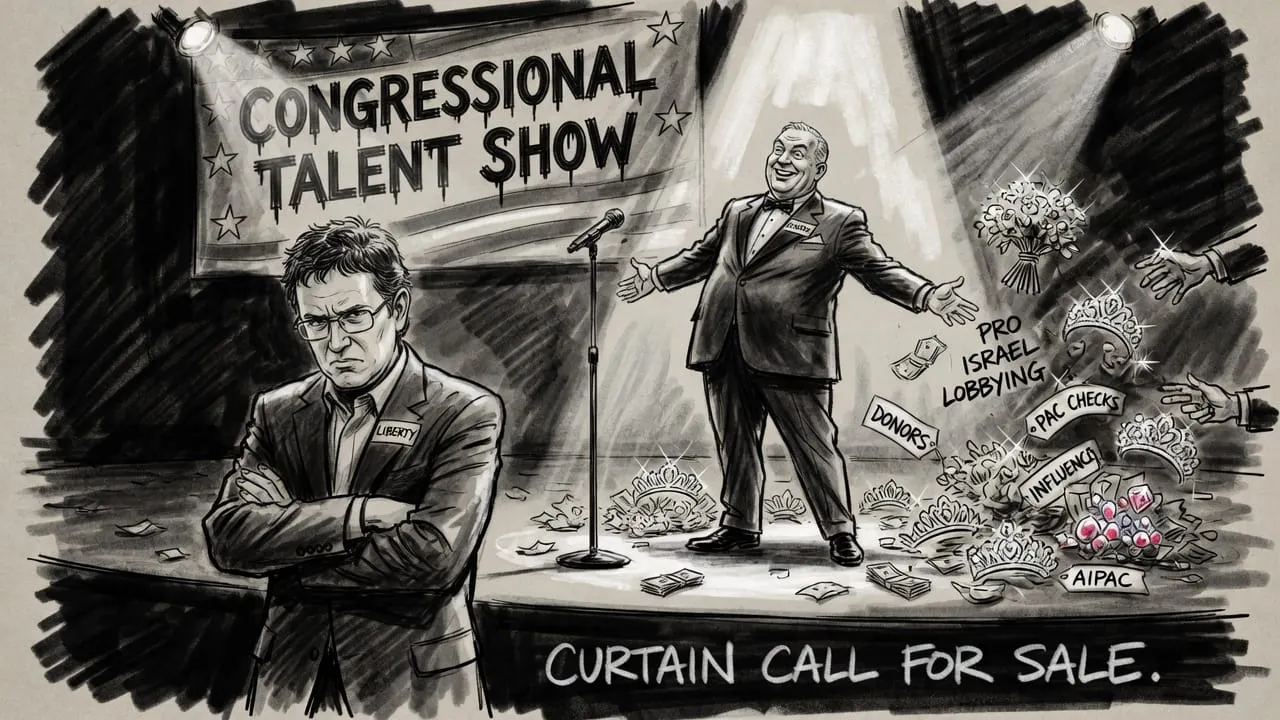
Of the spending arrayed against Massie, the largest single bloc came from pro-Israel political organizations and donors closely associated with them. Massie has publicly stated that approximately 95 percent of the funding behind his opponent traces back to pro-Israel sources. Federal Election Commission (FEC) records and reporting by Politico, Axios, Reuters, the Daily Caller, and Al Jazeera confirm that pro-Israel groups directly spent more than $9 million in independent expenditures against Massie, while pro-Israel donors funneled millions more through Trump-aligned super PACs.
This report examines the historical context of the race, profiles Thomas Massie and the political positions that made him a target, catalogs the organizations and individual donors spending against him along with their motivations, identifies the supporters and PACs that rallied to his defense, and analyzes the principal narrative attacks used in the campaign.
How a House Primary Became the Costliest
In U.S. History, the U.S. House primary elections historically attract modest sums compared with Senate, gubernatorial, or presidential contests. A typical competitive House primary draws between $1 million and $5 million in total spending. The 2026 Kentucky 4th District Republican primary shattered every prior benchmark. Before Massie’s race, the most expensive House primary on record was the 2024 New York Democratic primary that unseated Representative Jamaal Bowman, followed by the 2024 Missouri Democratic primary that defeated Representative Cori Bush. Both contests featured heavy spending by AIPAC’s super PAC arm, United Democracy Project. The Massie race surpassed both. The table below summarizes how the 2026 Kentucky 4th contest compares with previous record-setting House primaries:
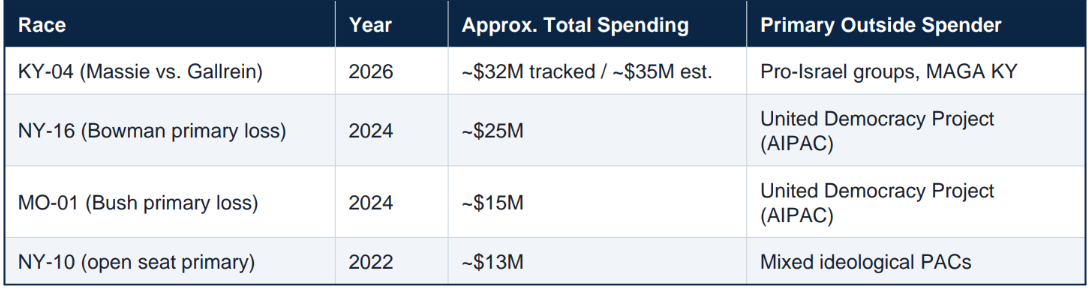
Spending in the Massie race accelerated dramatically in the final two months of the campaign. As of mid-March, MAGA KY had spent roughly $1 million on anti-Massie advertising. By May 16, total outside spending had crossed $20 million, and by primary day total advertising had risen to roughly $32 million according to AdImpact, with broader estimates placing the all-in figure at $35 million.
Who Thomas Massie Is and What He Represents
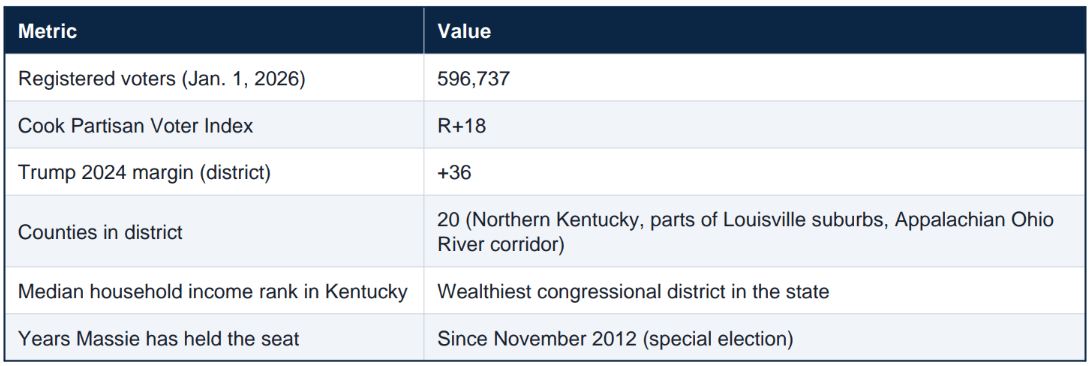
Thomas Massie is a Republican congressman from Kentucky’s 4th Congressional District, which spans Northern Kentucky’s suburbs of Cincinnati, the northeastern Louisville suburbs, and a stretch of rural Appalachian communities along the Ohio River. Massie has held the seat since winning a 2012 special election.
Background
A native of Lewis County, Kentucky, Massie earned bachelor’s and master’s degrees in mechanical and electrical engineering from the Massachusetts Institute of Technology. He is the founder of a haptic technology company and operates a working farm in his district. He is also widely considered one of the most technically credentialed members of the House.
Political Identity
Massie is a libertarian-leaning Republican who has built a national reputation as one of the most independent voters in Congress. He frequently casts the lone dissenting vote on symbolic resolutions and is a consistent opponent of deficit spending, foreign aid, and what he calls executive overreach. His voting record has aligned with President Trump roughly 91 percent of the time according to public records, but his deviations have come on issues of war powers, foreign assistance, federal spending, surveillance, and the release of records related to Jeffrey Epstein.
Massie has survived every prior primary challenge by wide margins. As he wrote on X in response to Trump’s March 2025 threat to back a primary challenger: “Three times I’ve had a challenger who tried to be more MAGA than me. None busted 25% because my constituents prefer transparency and principles over blind allegiance.” He has won every previous primary since entering Congress in 2012 with more than 70 percent of the vote, making the 2026 contest the first serious threat to his reelection.
Key Legislative Positions
- Opposed every appropriations package containing foreign aid, including aid to Israel and Ukraine.
- Cast the sole 2021 Republican vote against supplemental funding for Israel’s Iron Dome system.
- Led a 2026 War Powers Resolution to remove U.S. forces from hostilities with Iran.
- Sponsored the Epstein Files Transparency Act, pushing for the release of government records related to Jeffrey Epstein.
- Voted against the One Big Beautiful Bill Act (OBBBA), citing concerns about deficit spending and the debt ceiling.
- Co-chaired the Second Amendment Caucus with Representative Lauren Boebert.
- Introduced the Americans Insist on Political Agent Clarity (AIPAC) Act in the closing days of the 2026 primary, which would require AIPAC to register under the Foreign Agents Registration Act.
- Sponsored the PRIME Act protecting small farms and local meat processing.
- Voted against renewals of Section 702 of FISA without significant warrant reforms.
District Profile
The Challenger: Ed Gallrein
Ed Gallrein, the Trump-endorsed challenger, is a retired Navy SEAL officer, businessman, and fifth-generation farmer from Shelby County in the southern portion of the 4th District. He has never held elective office and in 2024 he ran for the Kentucky state Senate and narrowly lost the Republican primary to fellow Navy SEAL Aaron Reed; Gallrein requested a recanvass, but the result was still upheld.
Trump made his “Complete and Total Endorsement” of Gallrein public on October 17, 2025, via Truth Social, urging him to “RUN, ED, RUN.” Gallrein formally entered the race on October 21, 2025, framing his candidacy around loyalty to the president and characterizing Massie as an obstructionist. Prior to his official entry, MAGA KY had already begun running anti-Massie advertising on his eventual behalf.
During the campaign, Gallrein faced public scrutiny over questions raised in reporting concerning his military awards and divorce records. He also declined multiple invitations to debate Massie, a pattern Massie’s campaign and allies attacked repeatedly, with former Representative Marjorie Taylor Greene calling Gallrein “too timid, too weak, and too afraid” to appear in district debates.
Organizations Funding the Opposition to Thomas Massie
Anti-Massie spending was channeled primarily through three categories of outside groups: pro-Israel super PACs, a Trump-aligned super PAC (MAGA KY) funded substantially by pro-Israel donors, and a constellation of smaller ideological PACs aligned with the Trump-endorsed challenger.
Pro-Israel organizations have publicly stated that defeating Massie is a priority because of his sustained opposition to military aid to Israel and his vocal criticism of Israeli policy under Prime Minister Benjamin Netanyahu. United Democracy Project spokesperson Patrick Dorton told Politico that Massie is “the most anti-Israel Republican in the House.” Sam Markstein, the Republican Jewish Coalition’s national political director, framed the contest as part of an effort to ensure pro-Israel voices remain dominant inside the Republican Party.
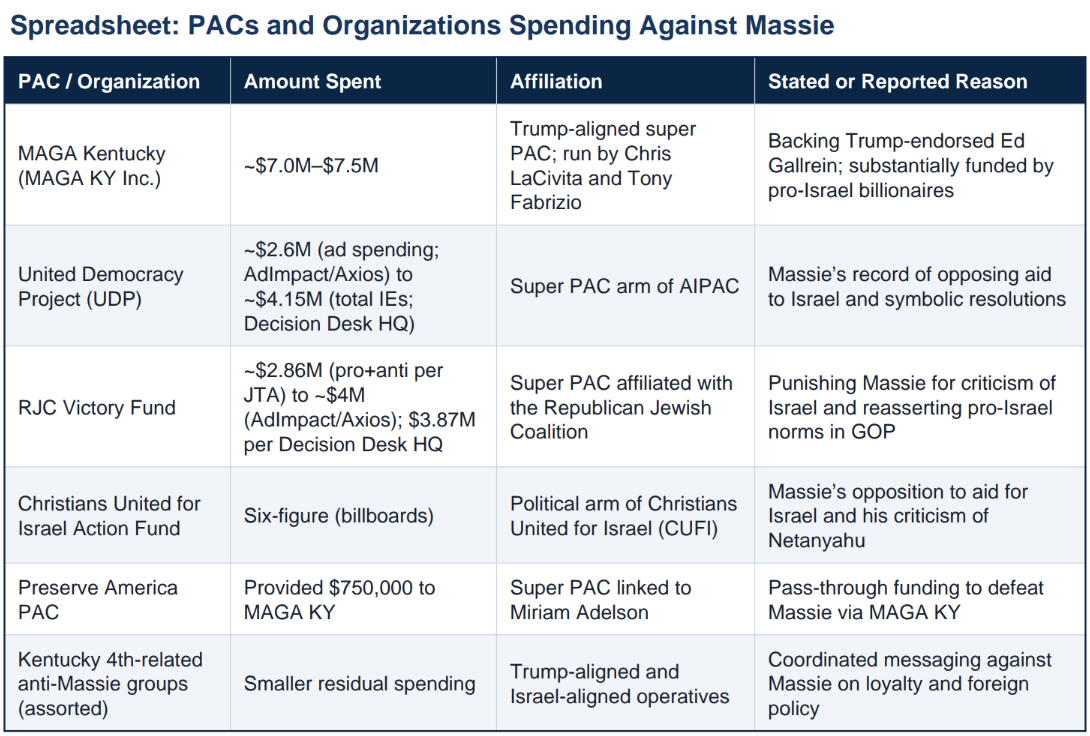
How Pro-Israel Money Reached MAGA KY
MAGA Kentucky is technically a Trump-aligned super PAC, but its top funders are dominated by pro-Israel donors. Public filings and reporting from Politico, the Daily Caller, and Al Jazeera document the following flows:
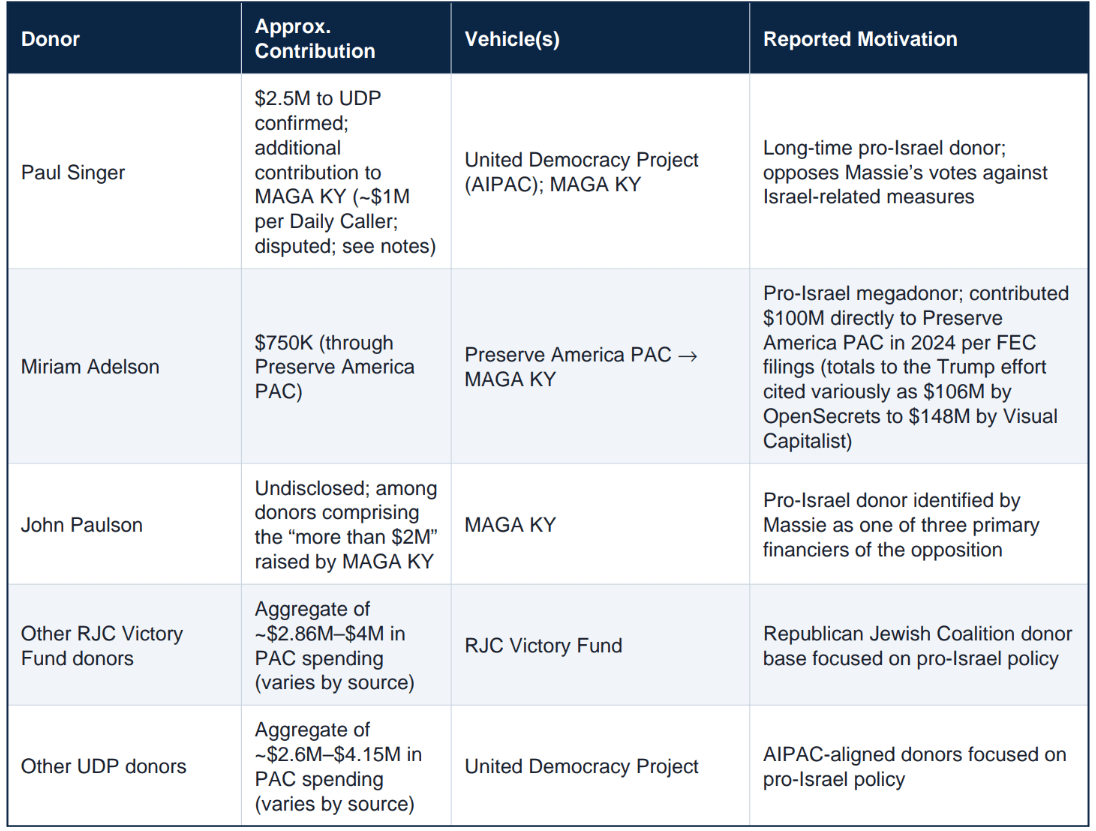
- Hedge fund manager Paul Singer contributed $2.5 million to AIPAC-affiliated United Democracy Project (the largest individual donation to UDP over the prior year per Al Jazeera). He also contributed to MAGA KY: the Daily Caller reports a $1 million direct contribution from Singer to MAGA KY, while Axios reports that MAGA KY raised “more than $2 million” combined from Paul Singer, John Paulson, and an Adelson-linked group, so the exact Singer share remains disputed.
- Preserve America PAC, which is associated with casino magnate Miriam Adelson, contributed $750,000 to MAGA KY.
- Hedge fund manager John Paulson is among the major donors identified by Massie as funding the anti-Massie effort, contributing through MAGA KY.
- Massie has stated that approximately 95 percent of the funding behind his opponent originates from pro-Israel sources, naming AIPAC, the Republican Jewish Coalition, and Christians United for Israel, plus the three billionaires above.
On the Tucker Carlson podcast in May of 2026, Massie directly named the three pro-Israel organizations he identified as driving the funding against him: AIPAC, the Republican Jewish Coalition, and Christians United for Israel. He paired that list with the three billionaires he held responsible which was Paul Singer, Miriam Adelson, and John Paulson and said the operation was of a scale “they’ve never done in any Republican race ever before.”
Individual Donors Funding the Opposition
Reporting consistently points to a small number of billionaire donors driving the financial campaign against Massie. None of the principal donors reside in Kentucky, and none have prior ties to the 4th District. The Lexington Herald-Leader found that anti-Massie super PAC spending was “funded exclusively by donors from other states.”
Major Individual Donors Aligned Against Massie
Notes on the Donor Network
Singer, Adelson, and Paulson have each historically supported pro-Israel candidates and causes. Estimates of Adelson’s 2024 support for Donald Trump’s presidential campaign vary by source and methodology: OpenSecrets puts her total support of the Trump campaign effort at approximately $106 million, Visual Capitalist estimates roughly $148 million, and Track AIPAC cites $120 million through Preserve America PAC. FEC filings show her direct 2024 contributions to Preserve America PAC totaled $100 million, paid in installments through July, August, and September of that year. Trump has publicly acknowledged that Adelson and her late husband Sheldon Adelson have influenced his Middle East policy decisions.
Of the donors who gave the maximum allowable contribution directly to Gallrein’s campaign committee, 85 percent had a prior history of donating to Democratic candidates, according to an FEC records review conducted by the Daily Caller. The pattern reinforces the impression that the campaign to unseat Massie cuts across the conventional partisan line.
Who Supported Thomas Massie
Although Massie was vastly outspent on the outside-spending side, he led in direct campaign fundraising, raising approximately $5.5 million for his principal campaign committee. His support base spanned grassroots donors, libertarian and pro-life PACs, fellow members of Congress, and prominent right-leaning media voices. About 76 percent of his first-quarter 2026 donors were new to his campaign, and his “Save the Republic Money bomb” raised more than $1 million in a single push during May 2026.
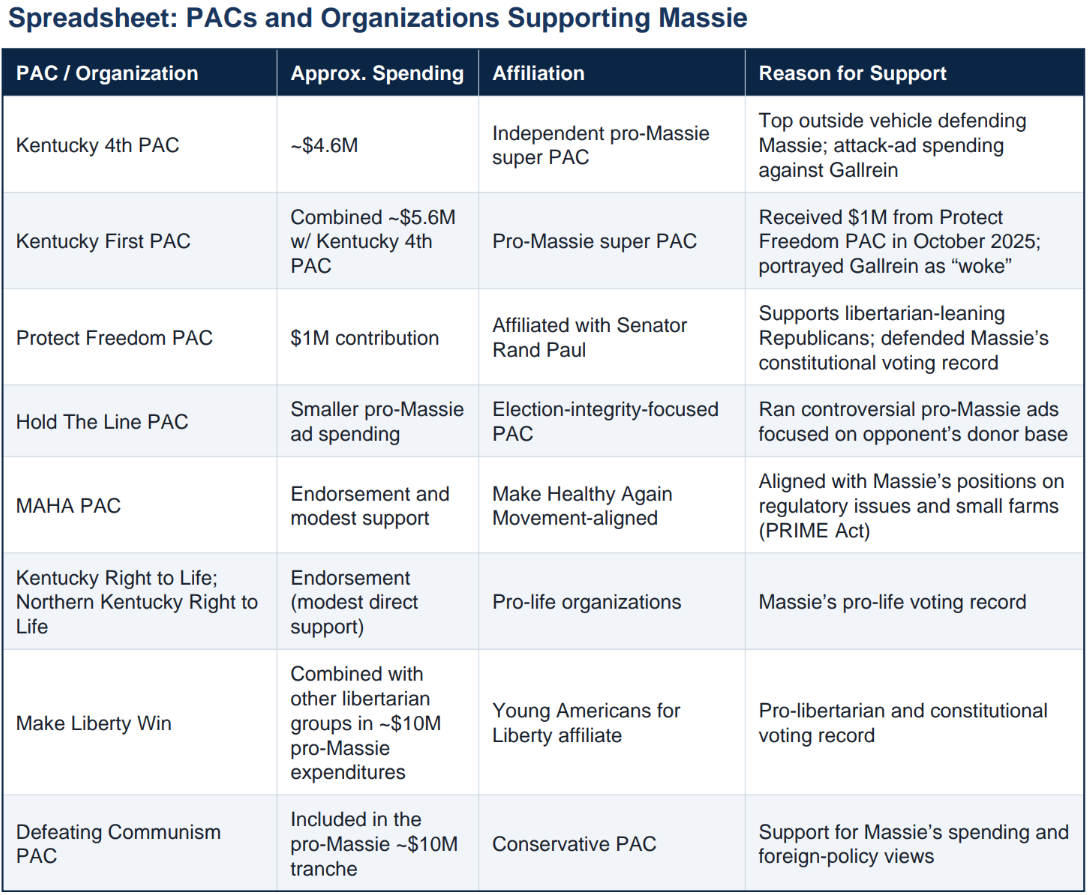
Notable Endorsements
Massie’s endorsers crossed several factions of the conservative movement and the right-leaning media world:
- Senator Rand Paul (R-Kentucky)
- Representative Lauren Boebert (R-Colorado), who faced public retaliation from President Trump for the endorsement
- Representative Warren Davidson (R-Ohio)
- Representative Victoria Spartz (R-Indiana)
- Former Representative Marjorie Taylor Greene (R-Georgia)
- Former Representative Matt Gaetz (R-Florida)
- Former Representative Justin Amash (L-Michigan, formerly R)
- Former Representative Dana Rohrabacher (R-California)
- Tucker Carlson, who devoted a podcast episode and newsletter editions to defending Massie
- James Fishback, candidate for Florida governor
- Megyn Kelly, who criticized the campaign against Massie on her program
What Massie Has Said and Done to Provoke the Opposition
The campaign to unseat Massie did not emerge from a single statement. It was the cumulative result of years of votes and public commentary on issues that diverged from the Trump administration’s foreign-policy posture and from positions favored by major pro-Israel organizations.
On Foreign Aid and Israel
- Voted against every foreign aid appropriations package containing aid to Israel during his tenure in Congress.
- Cast the only Republican vote against supplemental Iron Dome funding in 2021.
- Voted against numerous symbolic resolutions supporting Israel and condemning antisemitism, calling them “meaningless” and arguing that some violated the First Amendment or conflated anti-Zionism with antisemitism.
- In May 2026, publicly called for halting all military aid to Israel, citing civilian casualties in Gaza and arguing Israel should fund its own defense.
- Stated on the Tucker Carlson podcast in May 2026 that at least 95 percent of the funding behind his primary opponent came from the pro-Israel lobby, naming AIPAC, the Republican Jewish Coalition, Christians United for Israel, and the trio of Singer, Adelson, and Paulson.
- Introduced the Americans Insist on Political Agent Clarity (AIPAC) Act on the eve of the primary, which would amend the Foreign Agents Registration Act of 1938 to require AIPAC lobbyists to register as foreign agents.
- Argued the United States was “forced” into the Iran conflict by Israeli pressure.
- Drew a clear distinction between criticism of the Netanyahu government’s policies and antisemitism, stating he is “not antisemitic” and “not against Israel.”
Massie’s Own Words
Several specific statements from Massie have been cited by opponents and supporters alike as flashpoints. In an April 2026 Politico interview after a candidate forum in his district, Massie said: “Does Israel have the right to exist? Every country has a right to exist.” He continued: “Why do you need 30 resolutions on the floor of the House to support Israel?” In commentary on the U.S. role in the Iran conflict, he argued that Israel had “forced our hand and dragged us” into hostilities. On the Tucker Carlson podcast, he framed his position bluntly: “Their position is more war, it’s more strife, it’s more bombs, it’s more foreign aid, and those are the things that I’ve been voting against.”
On War Powers and Iran
In March 2026 Massie introduced a War Powers Resolution to remove U.S. armed forces from hostilities with Iran. The effort failed but generated significant Republican backlash. Massie has consistently characterized the broader pattern of U.S. military involvement in the Middle East as a series of proxy wars in which Americans bear costs disproportionate to American interests.
On the Epstein Files and Domestic Issues
- Led congressional efforts to release the government’s files on Jeffrey Epstein, ultimately advancing the Epstein Files Transparency Act.
- Voted twice against the One Big Beautiful Bill Act, citing deficit and debt-ceiling concerns.
- Opposed reauthorization of Section 702 of FISA without significant warrant reforms.
- Helped block what he called the “Protect American AI Act,” which he argued would grant data centers immunity from lawsuits.
- Passed the PRIME Act protecting small farms and local meat processors.
Has been one of a small number of Republicans to call for transparency on the Epstein files even after public criticism from the Trump administration and Department of Justice.
Principal Narrative Attacks Against Massie
The advertising campaign against Massie deployed several distinct narratives. Some focused on his record; others used AI-generated imagery; still others drew on direct attacks from the President of the United States.
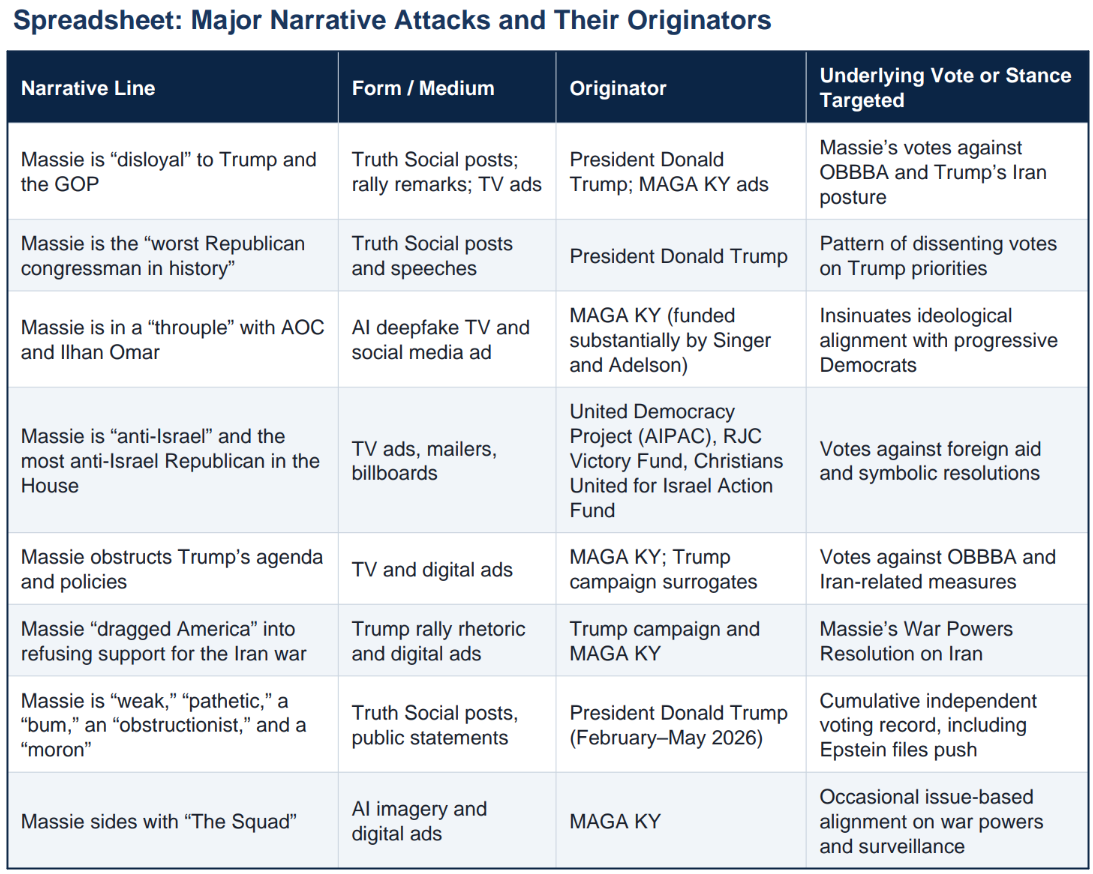
The AI Deepfake Controversy
Among the most contested moments of the campaign was a MAGA KY-funded ad showing AI-generated images of Massie holding hands with Representatives Alexandria Ocasio-Cortez and Ilhan Omar and dining together. A small disclaimer described the spot as a “satirical” AI creation. Former Representative Marjorie Taylor Greene argued the ad violated the federal TAKE IT DOWN Act, which prohibits the publication of non-consensual intimate imagery, including AI-generated content. A separate AI ad from the pro-Massie Kentucky 4th PAC depicted Gallrein fleeing a battlefield, a depiction the Gallrein campaign called “an insult to all veterans.”
Presidential Pressure
The Massie–Trump feud predates the 2026 primary by more than five years. The friction began in March 2020, when Massie attempted to force a recorded vote on the CARES Act COVID-19 relief bill, demanding that members of Congress travel to Washington to vote in person rather than pass the largest spending bill in history without a roll call. Trump publicly demanded Massie’s expulsion from the Republican Party at the time, calling him a “third-rate grandstander.” The relationship deteriorated further across Trump’s second term, particularly after Massie was one of only two House Republicans to vote against the One Big Beautiful Bill Act.
In the 2026 cycle, Trump campaigned actively against Massie. In March 2026 he traveled to Hebron, Kentucky for a rally with Gallrein. In the 24 hours before primary day, Trump fired off at least four Truth Social posts attacking Massie. Defense Secretary Pete Hegseth traveled to Kentucky on Gallrein’s behalf, an unusual and reportedly unprecedented deployment of a sitting Cabinet member (and a Pentagon chief specifically) into a sitting Republican congressman’s primary. When Representative Boebert endorsed Massie, Trump publicly encouraged a primary challenge against her, calling her “weak minded” and a “carpetbagger.”
Polling-Location Changes Before Primary Day
Reporting in the closing week of the campaign documented that early-voting polling locations across the 4th District were changed without prior notice approximately one week before the election. According to the reporting, the changes invalidated the addresses printed on millions of mailed ballots, introducing administrative confusion into a contest already saturated with outside messaging. The change drew complaints from Massie’s campaign and supporters who characterized it as an election-administration concern amplifying the chaos of an already turbulent race.
What the Race Represents
The 2026 Kentucky 4th Congressional District Republican primary became a stress test for two intersecting forces in American politics: the political power of pro-Israel donor networks within the Republican Party and the emergence of an “America First” foreign-policy skepticism inside the GOP.
The 2026 Kentucky 4th Congressional District Republican primary became a stress test for several intersecting forces in American politics: the political power of pro-Israel donor networks within the Republican Party, the emergence of an “America First” foreign-policy skepticism inside the GOP, and the use of AI-generated imagery in campaign advertising.
Thomas Massie’s defeat stands as one of the most damning illustrations of how thoroughly foreign-policy lobbying interests have captured the Republican Party and exposing the GOP that has abandoned any pretense of representing the American working and middle class it claims to champion. Three billionaires, an organization that the congressman himself has sought to compel to register as a foreign agent, and a president who once campaigned against endless wars would have combined to remove a five-term incumbent whose primary offense was voting against unconditional military aid to a foreign government and questioning whether the United States should be drawn into another Middle East conflict.
The roughly 95 percent of the opposition funding traced to pro-Israel sources, the unprecedented deployment of a sitting Defense Secretary into a House primary, and the willingness of party leadership to punish Representative Lauren Boebert simply for endorsing a colleague would all reveal a Republican Party in which dissent on Israel policy is treated as a disqualifying offense, regardless of a member’s voting alignment with the president on every other issue.
The American people would be left with a clear lesson: that a party which once branded itself as the voice of forgotten Americans now polices its own ranks on behalf of foreign-policy donors, that its rhetoric about draining the swamp dissolves the moment the swamp writes large enough checks, and that the working-class voters who delivered the GOP its 2024 victories have been governed by a coalition more responsive to Paul Singer, Miriam Adelson, and John Paulson than to the citizens of Lewis County, Kentucky.