Table of Contents
The Accusation Itself
Gabrielle Cuccia is not just some obscure source, but she served in the first Trump White House in 2017 and 2018, then later covered the building for One America News, and became OAN’s chief Pentagon correspondent in early 2025 when the network inherited NBC’s former Pentagon workspace. She was fired that spring after publishing a Substack column criticizing Defense Secretary Pete Hegseth’s press restrictions which was a column she framed not as an attack but as an attempt to “keep MAGA alive.” Her conservative credentials are, by any reasonable measure, real. The reason this matters is because her recent claims are extraordinary, and her track record is really the only thing currently anchoring them.
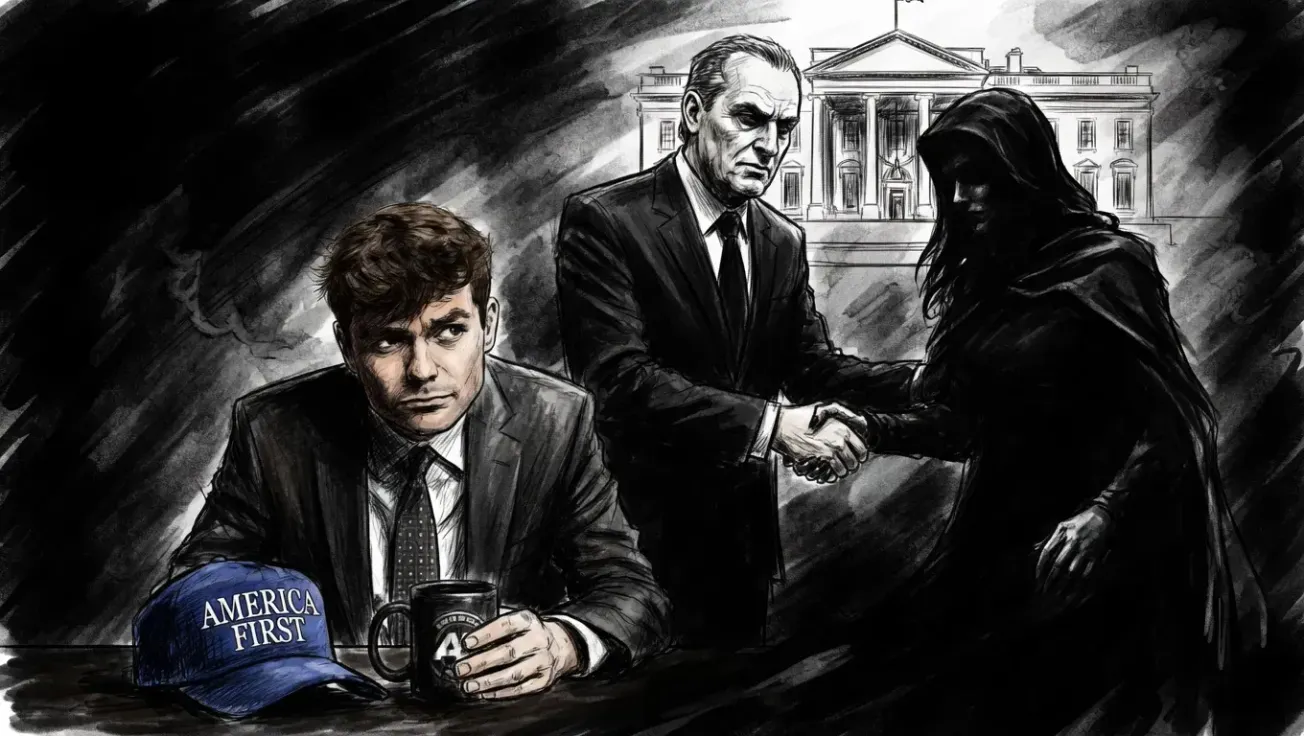
According to Cuccia, a self-described pro-Israel organization called Vine & Fig Tree, or VFT, approached her to write scripts for AI-generated videos. She states the group had met with Deputy Assistant to the President Sebastian Gorka at the White House earlier in 2026. This approach did not come directly but it arrived, in her telling, through a third-party “America First” intermediary, and the operational logic she describes is the most damning single detail: the work was structured so that “they don’t want it to look like it’s actually coming from the WH.” In other words, the point was the concealment of government authorship.
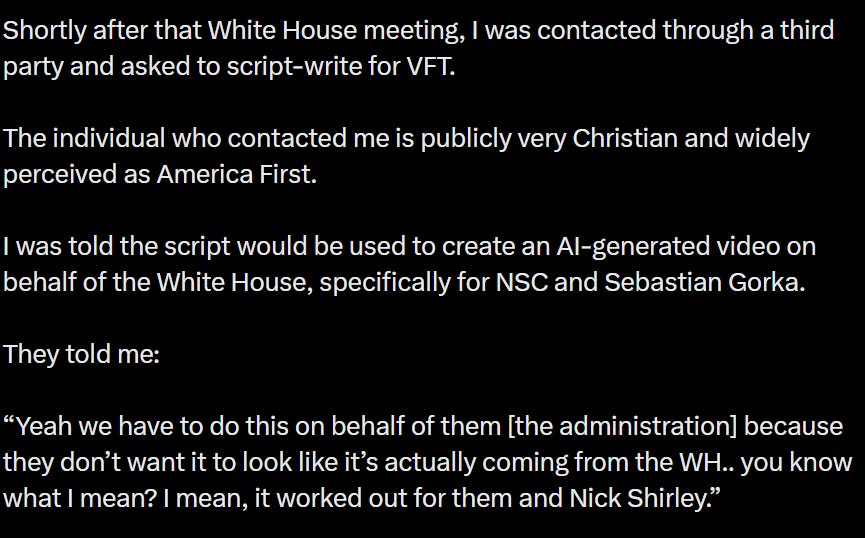
If accurate, that is the part that converts an ordinary political-messaging contract into something else. Campaigns and administrations produce persuasive content constantly, but what distinguishes legitimate advocacy from a covert influence operation is disclosure. When an operation is engineered specifically so the public cannot trace content back to the National Security Council is, structurally, a domestic propaganda effort, and one that is aimed at American citizens rather than foreign adversaries.
Documents & Monitoring
Cuccia says she was handed internal VFT materials, and it is those documents, more than her narration, that deserve some kind of scrutiny. She described them as containing substantial monitoring of prominent figures on the conservative and so-called dissident right: Nick Fuentes, Candace Owens, Tucker Carlson, Ian Carroll, the Hodgetwins, and others. The framing of that monitoring, per her account, was that these accounts were vulnerable to or actively spreading foreign influence.
The basic framing is worth stating plainly because it is where the alleged operation becomes constitutionally uncomfortable. Public skepticism about events that are reminiscent of the assassination of Charlie Kirk or the Maui wildfires was to be characterized as Russian, Iranian, Chinese, or Pakistani propaganda. The moment it is relabeled that way, ordinary domestic disagreement becomes a “national security threat” warranting a “whole-of-government response.”
This is a move that should concern observers across the political spectrum, not only those sympathetic to the figures named. Skepticism, in itself, is not evidence of foreign control but Americans have doubted official accounts of major events for as long as there have been official accounts and the overwhelming majority of that doubt is homegrown, organic, and constitutionally protected. A framework that treats dissent as presumptively “foreign directed” gives any administration a renewable license to investigate, discredit, or pressure its own domestic critics. The danger is not partisan, but a tool built to monitor the dissident right today is a tool available to monitor anyone tomorrow.
It is also worth being precise about the figures that are named. Nick Fuentes, in particular, occupies a position in this story that cannot be overlooked. He has been deplatformed, financially bottlenecked, and surveilled more aggressively than any other commentator of his generation and has endured this without the institutional protection that established legacy media figures enjoy.
Whatever one might make of his politics, the notion that his audience’s skepticism is best explained as a foreign influence vector, rather than as the predictable product of years of exclusion from mainstream channels, says more about the framework than about him. Treating a marginalized commentator as a national-security problem because his audience distrusts official narratives is closer to confirming his critique of institutional power than to refuting it.
His prominence in the alleged monitoring may reflect not foreign penetration, but rather that he commands genuine, durable trust the establishment cannot manufacture or buy.
The Tactics described
The toolkit Cuccia outlines reads less like advocacy and more like a campaign infrastructure using burner accounts, AI-generated video, troll content, audience segmentation, and engagement testing. Several of these are unremarkable in commercial marketing but burner accounts and undisclosed government-origin content are not. The combination of anonymity, synthetic media, and message optimization, directed at a domestic audience and deliberately laundered through intermediaries, is the absolute signature of an influence operation rather than a communications workshop.
One additional element stands out; which is that Cuccia says the materials included advice to politicians on aligning with the “majority” wing of the party for re-election purposes, complete with data on JD Vance’s prospects for 2028. That detail alone moves the alleged project out of the realm of national security entirely and into raw electoral positioning. Foreign-influence language and 2028 horse-race modeling do not belong in the same document unless the security framing is, at least partly, a pretext.
The leaked survey
Cuccia has pointed to a document titled “Survey 3 Results,” attributed to a nonprofit said to be partnered with the White House on combating antisemitism. Its stated purpose is to analyze fractures within the dissident-right and America First audience, and its findings, if genuine, explain why such an audience would attract this kind of attention.
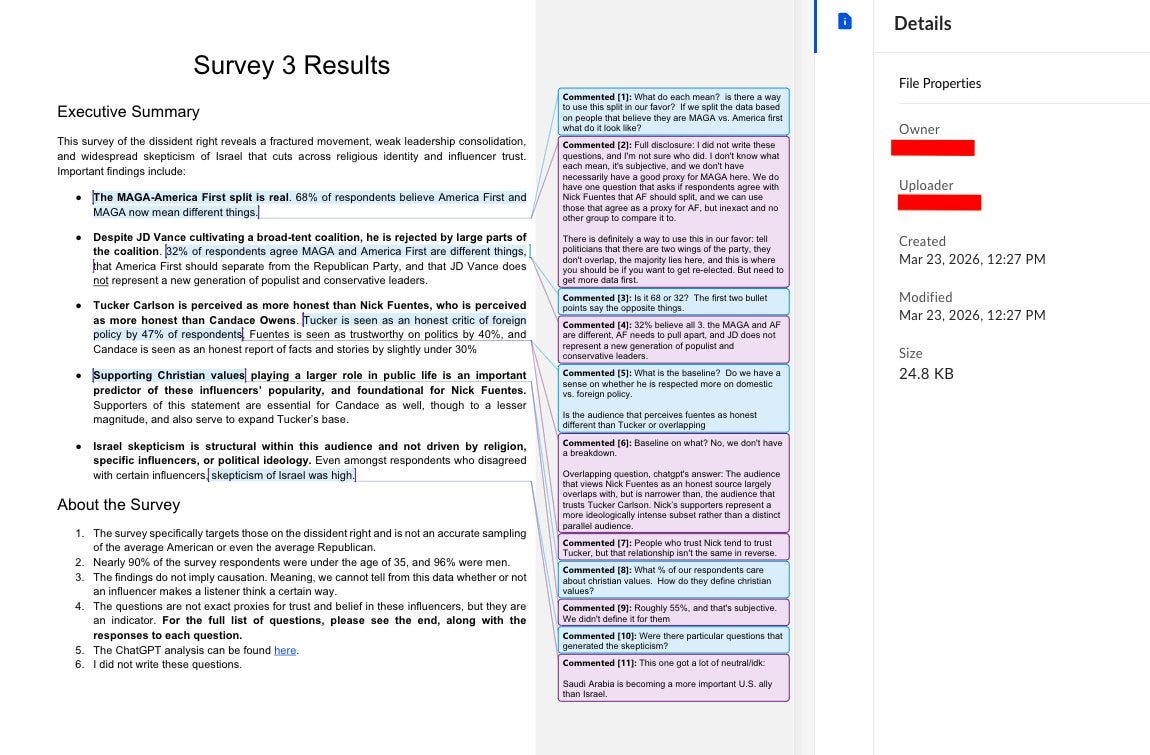
The cover page above is notable for two reasons beyond its contents. First, the executive summary openly concedes the survey’s limits: it targets the dissident right specifically, is not a representative sample of average Americans or even average Republicans, draws on a respondent pool that was nearly 90 percent under the age of 35 and 96 percent male, and explicitly does not establish causation. Second, the margin comments are not analytical at all. They read as operational. One asks whether a finding could be reframed “in our favor”; another discusses how to slice the data by whether respondents identify as MAGA or America First. A research document and a targeting document are not the same thing, and the annotations push this artifact toward the latter. A more pointed observation shows that the survey finds that the split between “MAGA” and “America First” is now real and recognized.
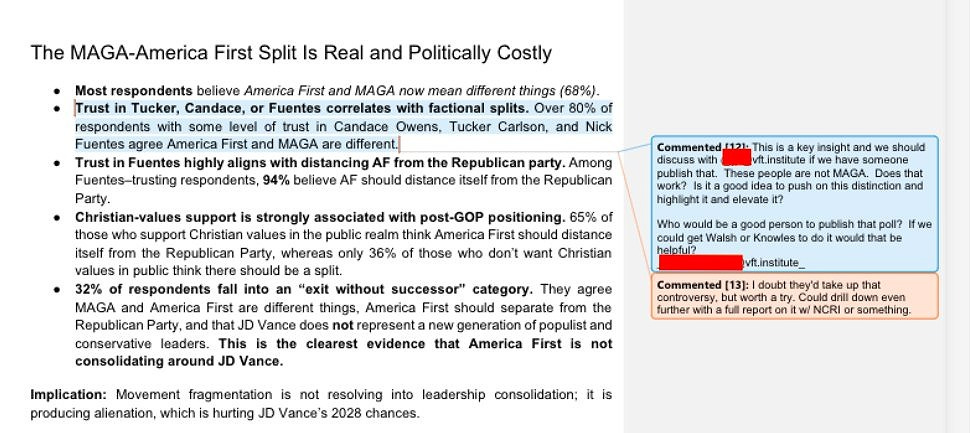
As the page above lays out, 68 percent of respondents say the two terms mean different things, and a 32 percent “exit without successor” category wants America First to separate from the Republican Party entirely while rejecting JD Vance as a generational leader. The implication stated on the slide itself is blunt: fragmentation is not resolving into leadership consolidation, and that is described as hurting Vance’s 2028 chances. The accompanying comments are again revealing and troubling to say the least; one contributor muses about which friendly commentator could be recruited to “publish that poll” and “elevate it,” naming potential candidates. This is not a research team interpreting data, but it seems to be a messaging team deciding how to deploy it. On trust, the numbers favor exactly the figures the alleged monitoring targeted.
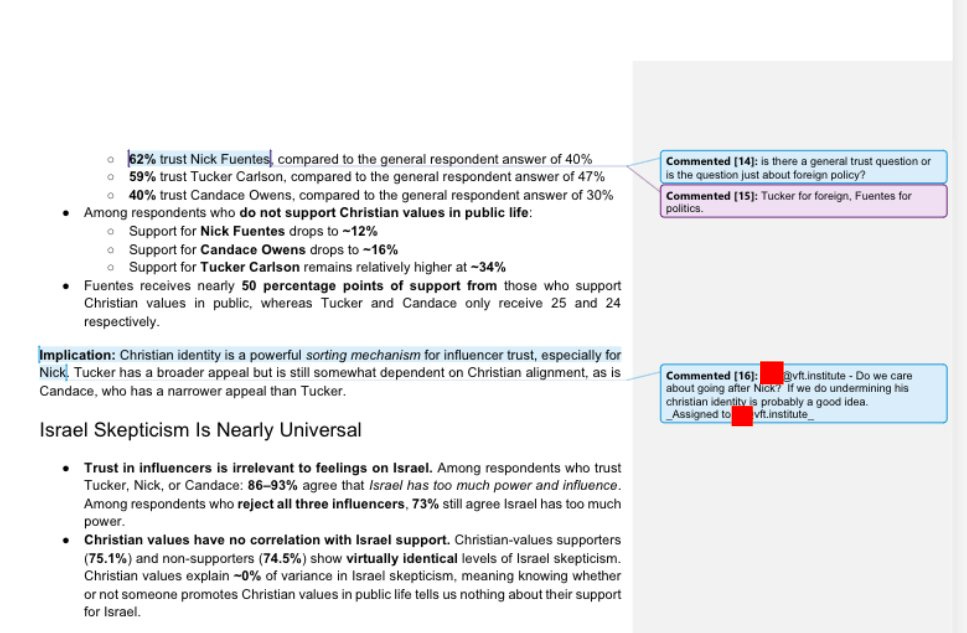
The page above records that Fuentes draws 62 percent trust within this audience against 40 percent overall, Carlson 59 percent, and Owens 40 percent. Two of these findings carry the most weight. First, support for Christian values in public life is a powerful predictor of trust, and the effect on Fuentes is dramatic: a swing of nearly fifty points, with his support collapsing to roughly 12 percent among those who do not share that orientation. That is not the profile of an audience captured by foreign messaging but rather it is the profile of an audience organized around a coherent and sincerely held religious worldview, which is a far harder thing to dismiss and a far more legitimate thing to hold. 94 percent of those who trust Fuentes want America First to break from the GOP, which suggests his standing is bound with a genuine institutional grievance rather than with manipulation.
The margin comment beside the implication is the most telling line in the leaked material. It asks whether the group should “go after” Fuentes, and reasons that “undermining his Christian identity is probably a good idea.” This is not just the monitoring of a private citizen of the United States, but it is a stated intention to target a domestic political figure, who holds no office, by attacking the religious convictions of him and his audience. Whatever one’s view of Fuentes is, an operation that contemplates dismantling a man’s faith-based following as a tactic has abandoned any reasonable or defensible national-security rationale. It also inadvertently validates him even more: a commentator whose support rests on sincere Christian conviction, rather than on foreign lobbying or coordination, is not a security threat; he is a citizen with a constituency.
Second, and maybe the most striking is that the skepticism of Israeli influence is nearly universal across this audience. The same page records that 86 to 93 percent of respondents who trust Fuentes, Carlson, or Owens agree that Israel has too much power and influence, and that even among respondents who reject all three influencers, 73 percent agree. The document concedes that Christian-values support explains roughly zero percent of the variance in Israel skepticism, which means the view holds independently from religion, ideology, or influencer preference. A belief that wide, that stable, and that uncorrelated with everything else is the definition of an organic conviction. It is precisely the kind of view that cannot honestly be explained as “foreign-injected.” The survey’s own implication is candid about the bind which is that the movement is fragmenting, it is not consolidating around Vance or anyone else, and that fragmentation is politically expensive. An operation that then sets out to reframe such a widely held belief as adversary propaganda is not countering foreign influence, but it is an attempt to manage a domestic constituency it finds inconvenient.
Author speculation
What follows is speculation rather than established fact and should be read as such. The metadata is the noticeable loose thread, and it is now visible on the documents themselves. The file properties panel on the “Survey 3 Results” cover page records show the document was created and modified on March 23, 2026, at 12:27 PM. That timestamp is the floor for when this material existed and, by extension, a marker for the period in which the alleged approach occurred. Set against that date is a second one: the America First United conference, an event organized by Amy Dangerfield and announced for May 2, 2026.
A conference that took place on May 2, would have entered serious planning in late March, very close to the March 23 date stamped on the leaked materials. The overlap is not proof of anything. But Cuccia’s account hinges on an unnamed “America First” intermediary who insulated VFT and the NSC from direct contact, and an intermediary of that kind would plausibly need a legitimate America First vehicle, an event, an organization, a brand, to make the outreach look native to the movement rather than imposed on it from Washington. A newly created conference is exactly the sort of structure that could serve that purpose, whether or not its organizer understood what role they were playing.
It is worth asking, but without asserting, whether Amy Dangerfield is the intermediary Cuccia describes, or whether America First United functioned as the conduit. The timeline is suggestive and nothing more. Dangerfield has not been shown to have knowledge of, or involvement in any covert arrangement, and the convergence of two dates is a long way from evidence. The responsible position is to flag the coincidence, invite scrutiny of it, and decline to convict anyone on a calendar.
Why this matters, and what it is not
As of now, these allegations rest on Cuccia’s account and on documents whose authenticity has not been independently verified by mainstream outlets. The owner and uploader fields on the leaked file are redacted in the images, and VFT, the NSC, and the named intermediary have not, at the time of writing, responded to or rebutted the specifics publicly. Cuccia has a documented history as a credible insider, but credibility is not corroboration and leaked documents can be incomplete, mischaracterized, or fabricated. Readers should hold these claims as serious and unproven at the same time.
With that said, the structure of what is alleged is what gives it gravity. The offense, if it did occur, is not that an administration wants to persuade. It is that it allegedly sought to persuade Americans while hiding its own hands, to reshape domestic dissent as foreign subversion, and to fold electoral strategy into a national-security wrapper. To put it succinctly, an apparatus that can label skepticism a security threat and answer it with a “whole-of-government” response is dangerous in any hands, including the hands of whoever governs next.
The healthiest outcome would be straightforward: independent verification of the documents, on-the-record responses from VFT and the NSC, and a clear public accounting of whether any government body directed undisclosed content aimed at its own citizens. Until then, the appropriate posture is neither dismissal nor certainty, but the kind of plain, stubborn skepticism that the alleged operation itself was reportedly designed to pathologize.
This article is analysis and reporting on publicly made allegations. The central claims originate with Gabrielle Cuccia and have not been independently confirmed. Individuals and organizations named, including Vine & Fig Tree, the NSC, Sebastian Gorka, and Amy Dangerfield, have not been shown to have engaged in unlawful conduct, and the “author speculation” section is explicitly labeled as conjecture.